Understanding Alternate and Same Side Angles in Geometry
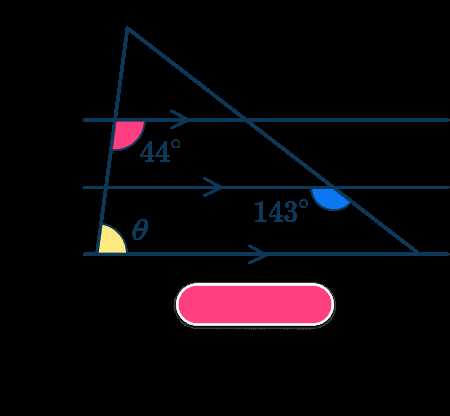
When working with two parallel lines intersected by a transversal, it is important to recognize the relationships between various formed pairs. Identifying corresponding, alternate, and co-interior pairs helps simplify many geometry problems. Start by noting that when two lines are parallel, certain angle pairs will be congruent, while others will be supplementary. Recognizing these properties immediately can save time in solving problems.
In this section, we will review how to identify pairs of angles that either lie on opposite sides of the transversal and are equal, or lie on the same side and are supplementary. Mastering these concepts allows you to solve complex geometry proofs with confidence. Understanding which angles are congruent or supplementary under specific conditions is key to applying the right theorems and strategies.
To help you apply these angle relationships effectively, we will break down the steps to identify and solve for unknown angles using diagrams. The more you practice identifying these relationships in a variety of contexts, the easier it becomes to solve even the most complex geometric problems.
Understanding Alternate and Same Side Angles in Geometry
When two parallel lines are intersected by a transversal, specific relationships form between the angles. These relationships can be used to solve geometric problems efficiently. The key to solving these problems is recognizing the specific properties of the formed angle pairs.
Alternate interior angles are located on opposite sides of the transversal, inside the parallel lines. These angles are always congruent when the lines are parallel. For example, if one alternate interior angle measures 50°, the other will also measure 50°.
Same side interior angles, or co-interior angles, are situated on the same side of the transversal and inside the parallel lines. These angles are supplementary, meaning their sum equals 180°. If one angle measures 60°, the other must measure 120° to satisfy this condition.
Recognizing these angle relationships allows you to solve for unknown angles in geometric diagrams. Once you identify the types of angle pairs, you can apply the correct geometric principles to find missing angle measurements quickly and accurately.
How to Identify Alternate Angles in Geometry
To identify opposite interior angles in a geometric diagram, focus on the configuration of the lines and transversal. Here’s how to do it:
- Locate two parallel lines: First, ensure the two lines are parallel. These lines must be cut by a transversal for angle pairs to form.
- Find the transversal: The transversal is the line that crosses the parallel lines. Look for angles on opposite sides of this line.
- Identify angle pairs: The angles that are on opposite sides of the transversal and between the parallel lines are opposite interior angles.
- Check for congruency: These opposite interior angles will always be congruent if the lines are parallel. Measure one, and the other will be the same.
By following these steps, you can quickly identify opposite interior angles and use their congruency to solve for missing angle measurements in geometric problems.
Understanding the Properties of Same Side Angles
To identify the characteristics of interior angles on the same side of a transversal, follow these steps:
- Parallel lines: These angles are formed when a transversal intersects two parallel lines.
- Adjacent location: The angles are situated on the same side of the transversal and between the parallel lines.
- Supplementary property: The sum of these angles always equals 180°. This is because they are supplementary.
- Angle identification: Typically, these angles are labeled as consecutive interior angles.
Understanding that these angle pairs are supplementary allows you to solve for unknown angles quickly by subtracting the known angle from 180°.
Common Mistakes in Identifying Alternate and Same Side Angles
Identifying angle pairs formed by a transversal and parallel lines can be tricky. Here are some common mistakes to avoid:
- Misidentifying angle types: A common error is confusing interior and exterior angles. Interior angles lie between the parallel lines, while exterior ones are outside them.
- Incorrect assumptions about supplementary angles: The angles on the same side of a transversal are always supplementary, meaning their sum is 180°. Failing to apply this rule leads to wrong calculations.
- Overlooking parallelism: The relationships only hold true if the lines are parallel. Non-parallel lines do not guarantee the same angle relationships.
- Confusing angle positions: Ensure that the angles are indeed on the same side or opposite sides of the transversal. Misplacement of angles often results in incorrect conclusions about their relationships.
By carefully observing the position of lines and angles, and checking if the lines are parallel, you can avoid these common mistakes. For more on angle relationships and geometry, refer to Khan Academy Geometry.
Solving Problems with Parallel Lines and Transversals
To solve problems involving parallel lines and a transversal, follow these key steps:
- Identify the type of angle pair: Determine whether the angles formed are corresponding, supplementary, or vertical. This will dictate how you can solve for unknowns.
- Use angle relationships: For parallel lines cut by a transversal, corresponding angles are congruent, and consecutive interior angles are supplementary. Apply these rules to simplify the problem.
- Label angles: Label the known angles in your diagram. This helps you visualize the relationships between the angles and identify missing values.
- Set up equations: When dealing with unknown angles, use algebra to set up equations based on the relationships between the angles (e.g., supplementary angles sum to 180°).
- Solve the equations: Solve the algebraic equations step by step to find the missing angle values.
By systematically applying the rules for angle pairs and using algebra to solve for unknowns, you can easily solve geometry problems involving parallel lines and a transversal.
How to Use Alternate and Same Side Angles in Proofs
To incorporate these angle relationships into proofs, follow these steps:
- Identify the transversal: Start by locating the transversal that intersects two parallel lines. This will help determine the angle pairs involved in the proof.
- Determine the angle relationships: Use the properties of angle pairs. For instance, alternate angles are congruent, while consecutive interior angles are supplementary. These relationships are crucial for building logical arguments in proofs.
- Apply these relationships to your proof: Use the given angles in the problem to establish equations. For example, if you know that alternate angles are congruent, set them equal to each other and solve for unknown values.
- Use algebraic steps to justify each angle: If you’re working with unknown angles, apply algebraic methods to find the missing angle measures. Each step should be justified with the correct angle relationship.
- Conclude with the desired result: Once the necessary angle measures are determined, use them to complete the proof and reach the conclusion.
By following these steps, you can effectively use angle relationships in geometric proofs, ensuring a clear and logical argument from start to finish.
Real-World Applications of Alternate and Same Side Angles
These relationships between angles play a significant role in various fields, including architecture, engineering, and design. Here’s how they apply in real-world scenarios:
- Construction and Architecture: When constructing buildings or bridges, engineers use angle properties to ensure that beams, columns, and supports are placed accurately. For example, understanding how two beams interact at specific angles helps maintain structural integrity and balance.
- Design and Artwork: Artists and designers use geometric principles, such as congruent and supplementary angles, to create balanced and symmetrical designs. This can be seen in everything from graphic design to interior decorating, where angle relationships impact aesthetics and functionality.
- Transportation and Navigation: In the design of roads, railways, and even aircraft, knowing the relationships between intersecting lines is crucial. For instance, when constructing rail tracks, engineers use these principles to align tracks and ensure smooth travel paths.
- Robotics and Machine Engineering: Robots that require precise movements, such as arms in manufacturing plants, rely on accurate angle measurements to function correctly. The programming of their motions involves understanding the properties of intersecting lines and their resulting angle relationships.
- Surveying: Land surveyors use angle properties to map out land areas and calculate distances. Accurate readings of angle relationships help in plotting boundaries and ensuring that construction projects are correctly aligned with surveyed land.
These examples highlight the importance of understanding geometric angle properties in everyday applications, ensuring precision and functionality in multiple industries.
Tips for Visualizing and Drawing Angle Relationships
To accurately visualize and draw relationships between intersecting lines and their resulting angles, follow these steps:
- Use Graph Paper: Graph paper helps maintain straight lines and accurate measurements. Start by plotting two parallel lines, and then introduce a transversal to create the angle relationships you need to explore.
- Label Key Points: Label the intersections and lines involved in the diagram. This will help in referencing specific angle pairs and understanding their relationships clearly.
- Identify Key Relationships: Determine which pairs of angles are congruent, supplementary, or complementary. Mark these relationships with symbols or color-coding for easy identification.
- Draw with Precision: Use a protractor for precise angle measurements. Ensuring accuracy in your diagram will allow for better understanding and clearer problem-solving.
- Use Color for Clarity: Color-coding angles that share similar properties (e.g., alternate interior, corresponding) can make visualizing relationships much easier.
- Check Symmetry: In many cases, angle relationships involve symmetry. Identifying symmetrical patterns in your diagram will help confirm the accuracy of angle pairs.
- Practice Regularly: The more you draw, the easier it will become to visualize and identify relationships. Practice different scenarios with various angle pairs to improve your skills.
These strategies will make it easier to visualize angle relationships in geometry problems, improving your ability to solve them effectively.
Practice Problems for Mastering Angle Relationships
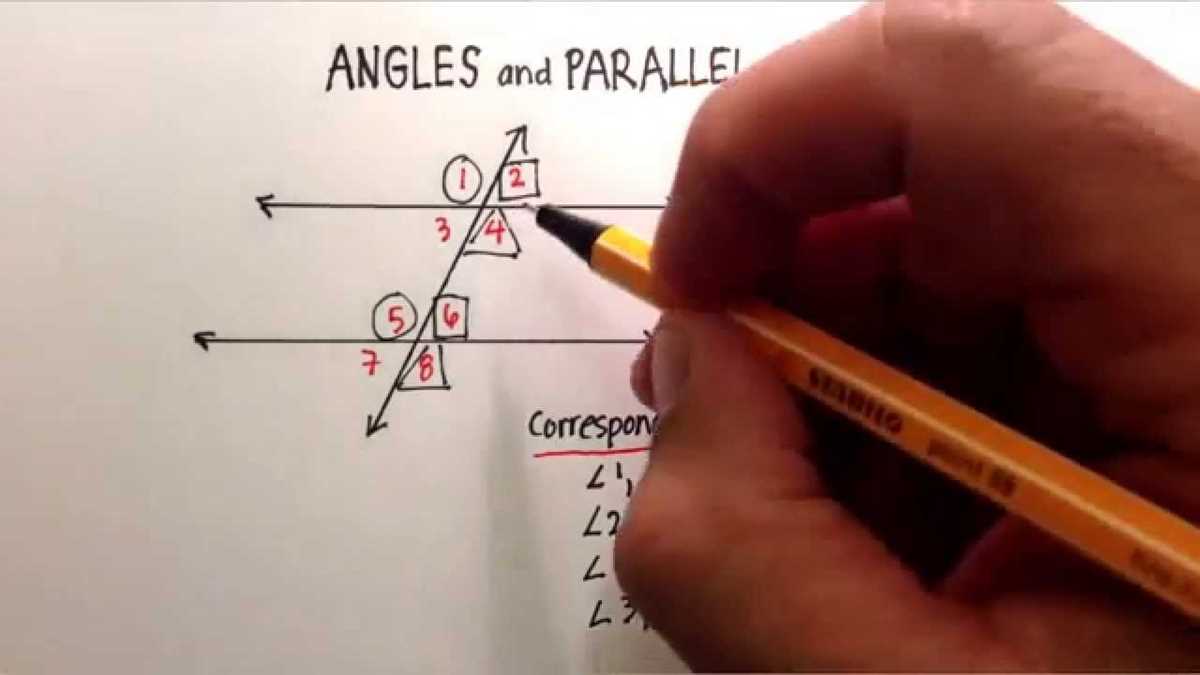
To develop a solid understanding of angle relationships, practice with these examples:
- Problem 1: Given two parallel lines cut by a transversal, identify all pairs of angles that are congruent and supplementary. Draw the diagram and label the angle relationships.
- Problem 2: A transversal intersects two lines. If one of the angles measures 75°, calculate the measures of the remaining angles using angle pair relationships.
- Problem 3: In a diagram with parallel lines and a transversal, if one of the interior angles is 120°, find the other angles formed by the transversal.
- Problem 4: Given a transversal and two lines, identify all corresponding and alternate interior angles. Label the angles and solve for the unknown angle.
- Problem 5: If a transversal intersects two lines and one angle is given as 45°, use this information to find all other angle measures formed by the transversal and lines.
- Problem 6: Calculate the unknown angle if two lines are parallel and a transversal creates an angle of 90° and another angle that is twice its measure.
These problems will help reinforce the concepts of angle relationships and improve problem-solving skills.