Complete Solutions for Motion Graph Problems in the Worksheet
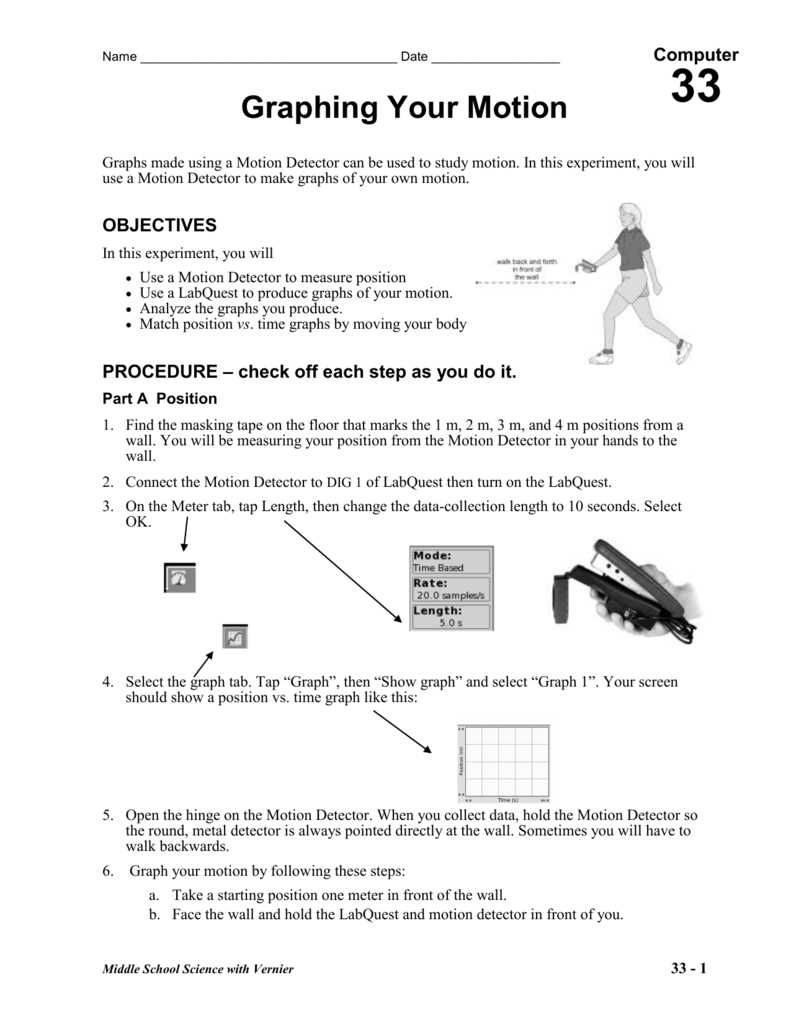
To successfully solve problems involving velocity, displacement, and time, focus on interpreting how the graph represents the motion of an object. Pay attention to the shape of the curve or line, as each segment can provide key information about the object’s movement–whether it’s at rest, moving with constant speed, or accelerating.
For each problem, begin by analyzing the axes of the graph. The x-axis typically represents time, while the y-axis shows displacement or velocity, depending on the type of problem. Identifying the scale and units used in the graph will help you accurately extract the necessary information.
Next, break down each segment of the graph. If the graph consists of straight lines, calculate the slope to determine the speed or velocity. Curved lines often indicate acceleration, and you may need to calculate instantaneous velocity or acceleration at specific points. Recognizing these patterns is key to finding the correct solution.
By understanding the connection between graph features and physical motion, you can apply the right formulas to solve for unknown values. This systematic approach will guide you through the process of analyzing and interpreting any graph you encounter in these types of problems.
Motion Graphs Problem Solutions
To solve the problem involving the displacement and velocity of an object, first identify the type of graph presented. For straight lines, calculate the slope to determine the velocity. For example, if the line is linear and slopes upwards, it indicates constant speed. The slope can be found by dividing the change in position by the change in time, giving the velocity.
In cases where the graph curves, this often represents acceleration. If the curve shows a steepening slope, the object is accelerating, and the acceleration can be calculated by finding the slope of the tangent line at a specific point. This gives the instantaneous rate of change of velocity.
For a graph representing velocity over time, pay attention to the area under the curve. The area between the velocity curve and the time axis corresponds to the displacement of the object. Use integration or estimate the area by counting squares on the graph if exact calculation tools are not available.
For problems where the graph includes multiple segments, break each section into individual parts. For each linear segment, calculate the slope or area, and for curved segments, calculate the instantaneous rate of change or use an approximation method to estimate the value. Be sure to consider any time intervals and units provided in the problem.
How to Interpret Motion Graphs in the Worksheet
Begin by analyzing the axes of the graph. The x-axis typically represents time, while the y-axis shows either displacement, velocity, or acceleration. Identifying the variables plotted on each axis is crucial for understanding the graph’s meaning.
For linear segments, calculate the slope. A straight line with a positive slope indicates motion in a specific direction, while a negative slope represents movement in the opposite direction. The steeper the slope, the greater the velocity or rate of change in position.
If the graph is curved, the slope is changing, which suggests acceleration. To determine acceleration, find the rate of change of the slope at any point along the curve. If the curve flattens out, the object is either at rest or moving with constant speed.
Pay close attention to any regions of the graph where the curve reaches zero. This often indicates the object is at rest, with no displacement or velocity at that moment. Similarly, when the graph is flat and above or below the axis, the object is either moving at constant velocity or accelerating at a constant rate.
To interpret graphs more effectively, practice with different types of charts, focusing on identifying key points where velocity or acceleration change. Websites like Khan Academy offer helpful examples and interactive exercises for visualizing and interpreting motion diagrams.
Step-by-Step Solution Process for Each Motion Graph Problem
1. Examine the Axes: First, check the x-axis and y-axis labels. The x-axis typically represents time, and the y-axis may represent position, velocity, or acceleration. Identifying these variables is the first step in understanding the graph.
2. Identify the Graph’s Segments: Break the graph into segments based on changes in the line’s slope or curvature. A straight line suggests constant motion or velocity, while curves indicate acceleration or deceleration. Analyze each segment individually.
3. Calculate the Slope (for Linear Sections): For straight line segments, calculate the slope to determine velocity. Use the formula: Slope = (Change in y) / (Change in x). This will give you the rate of change of position over time.
4. Analyze Curved Sections for Acceleration: If the graph is curved, identify the steepness of the curve. A steeper curve indicates greater acceleration. You can calculate instantaneous acceleration by finding the slope of the tangent line at a given point.
5. Find Areas Under the Curve (for Displacement or Distance): For velocity vs. time graphs, the area under the curve represents displacement. Calculate the area using geometric shapes like rectangles or triangles, or estimate it by counting squares on the graph.
6. Check for Zero or Flat Regions: Look for flat sections on the graph. A horizontal line at zero indicates that the object is stationary, while a non-zero horizontal line indicates constant velocity.
7. Calculate Changes in Velocity or Position: Use the information from the graph to find the object’s displacement, velocity, or acceleration. Pay attention to time intervals, as they are crucial for making accurate calculations.
8. Verify Your Results: After solving for the unknown values, cross-check them with the provided solution key to ensure your calculations are correct. Make sure to address any discrepancies and adjust as needed.
| Step | Action | Formula/Method |
|---|---|---|
| 1 | Examine the axes | Identify time and position/velocity/acceleration |
| 2 | Identify graph segments | Check for linear or curved segments |
| 3 | Calculate slope for linear sections | Slope = (Change in y) / (Change in x) |
| 4 | Analyze curves for acceleration | Find slope of tangent for instantaneous acceleration |
| 5 | Find area under the curve | Use geometric formulas for area |
| 6 | Check for flat or zero regions | Flat line = constant speed or rest |
| 7 | Calculate changes in velocity/position | Use formula based on graph interpretation |
| 8 | Verify your results | Cross-check with solution key |
Common Mistakes in Analyzing Motion Graphs and How to Avoid Them
1. Misinterpreting the Axes: The x-axis typically represents time, while the y-axis shows either position, velocity, or acceleration. Confusing these can lead to incorrect conclusions about the object’s motion. Always double-check the labels before proceeding with calculations.
2. Ignoring Units of Measurement: Units are critical when interpreting any graph. For instance, time may be in seconds and position in meters. Failing to account for these can lead to errors in calculation, especially when determining velocity or acceleration. Pay close attention to the unit of measurement indicated on the axes.
3. Overlooking the Sign of Values: The direction of motion is often indicated by the sign (positive or negative) on the graph. Mistaking a positive value for negative or vice versa can result in incorrect conclusions about the direction of motion or the velocity of the object. Ensure you understand the graph’s coordinate system.
4. Forgetting to Check for Curvature: In graphs depicting acceleration, a curved line usually indicates changing acceleration. Assuming constant motion where a curve is present can lead to errors. Identify curved sections and understand that they represent changing rates of velocity.
5. Confusing Instantaneous and Average Values: Instantaneous velocity or acceleration refers to values at a specific point in time, while average values are derived from the total change over a time interval. Confusing these two can lead to errors in understanding the object’s motion at any given moment.
6. Miscalculating Areas Under the Curve: The area under a velocity-time graph represents displacement. If the graph has sections with non-uniform shapes (such as curves), estimating the area can be tricky. Use geometric methods for simple shapes, and numerical methods or software for more complex curves.
7. Failing to Identify Zero Regions: A flat line at zero typically indicates that the object is at rest, while a constant non-zero flat line indicates uniform motion. Failing to recognize these patterns can result in missing key features of the motion.
8. Overlooking Changes in Slope: A change in the slope of the line represents a change in velocity (acceleration or deceleration). Missing or misinterpreting these points can lead to inaccurate analysis of how the object is speeding up or slowing down. Always assess the slope of the line carefully throughout the graph.
Key Concepts to Understand Before Solving Motion Graph Problems
1. Understanding Different Types of Curves: A straight line typically indicates uniform motion, while a curved line suggests acceleration or deceleration. It’s important to identify the type of motion represented by the graph before making assumptions about the object’s movement.
2. Relationship Between Time and Position: The x-axis typically represents time, and the y-axis shows position, velocity, or acceleration. Understanding how these variables are related is fundamental in solving motion problems, as different graph types indicate different aspects of motion.
3. Slope and Its Meaning: The slope of a line on a velocity-time graph represents acceleration. A steeper slope indicates a greater rate of change in velocity. Understanding how to calculate and interpret slope values is key to analyzing the motion accurately.
4. Area Under the Curve: The area under a velocity-time graph represents displacement, while the area under an acceleration-time graph gives the change in velocity. Be sure to understand how to calculate these areas and what they represent in terms of physical motion.
5. Zero Values: A horizontal line at zero on the velocity-time graph indicates that the object is at rest, while a horizontal line on a position-time graph means no displacement. Recognizing zero values helps in understanding when an object is not moving or changing its state of motion.
6. Understanding Acceleration: Acceleration is the rate of change of velocity. In velocity-time graphs, a changing slope indicates a change in acceleration. Recognizing these changes is important for understanding how the object’s velocity is increasing or decreasing.
7. Units of Measurement: Make sure to pay attention to the units used on the axes. Time is often measured in seconds, while position may be in meters or another unit. Incorrectly interpreting units can lead to errors in calculations or conclusions.
8. Interpreting Direction: Positive and negative values on position or velocity graphs indicate movement in different directions. Understanding the coordinate system and the direction of motion is crucial for correct analysis of the graph.
Using Graphs to Determine Speed, Velocity, and Acceleration
1. Speed Calculation from a Position-Time Graph: To determine the speed of an object, identify the slope of the position-time graph. The steeper the slope, the faster the object is moving. A constant slope represents constant speed, while a changing slope indicates variable speed.
2. Determining Velocity from a Position-Time Graph: Velocity is a vector quantity, meaning it includes both magnitude and direction. Positive slopes indicate motion in one direction, while negative slopes indicate motion in the opposite direction. Steeper slopes correspond to greater speeds, while horizontal lines indicate zero velocity.
3. Using a Velocity-Time Graph to Find Acceleration: Acceleration is the rate of change of velocity. In a velocity-time graph, a straight, non-horizontal line indicates constant acceleration. The slope of the line represents the magnitude of acceleration. A positive slope means increasing velocity, and a negative slope means decreasing velocity.
4. Speed from a Velocity-Time Graph: To find the speed of an object, look at its velocity at a specific point on the graph. If the graph shows positive values, the object is moving in the positive direction, while negative values indicate motion in the opposite direction.
5. Acceleration from a Velocity-Time Graph: The acceleration can be calculated by finding the slope of the velocity-time graph. For a straight line, simply calculate the change in velocity divided by the change in time. For a curve, find the slope at specific points to determine how the acceleration is changing.
6. Interpreting Zero and Horizontal Lines: A horizontal line on a position-time graph represents no change in position, indicating that the object is at rest. On a velocity-time graph, a horizontal line indicates constant velocity (no acceleration). A zero slope on the position-time graph indicates no motion, while zero velocity in the velocity-time graph signifies no movement.
7. Using the Area Under the Curve: In a velocity-time graph, the area under the curve represents displacement. By calculating the area, you can determine the total distance traveled by the object during the time interval shown.
8. Interpreting Changing Acceleration: If the velocity-time graph shows a curve instead of a straight line, the object’s acceleration is changing. To calculate the acceleration at a specific point, find the instantaneous slope of the velocity-time graph at that point.
Understanding the Relationship Between Position, Time, and Graph Slope
The slope of a position-time graph directly relates to the object’s velocity. A steeper slope indicates higher velocity, while a shallower slope suggests slower movement. Here’s how to interpret it:
- Positive Slope: If the slope is positive, the object is moving in the positive direction (away from the starting point).
- Negative Slope: A negative slope shows that the object is moving in the opposite direction (towards the starting point).
- Zero Slope: A horizontal line represents no change in position, meaning the object is stationary.
To calculate velocity, use the formula: velocity = (change in position) / (change in time). The slope gives the rate at which position changes over time, which is the velocity.
For varying motion, the slope changes. A curve indicates that the velocity is not constant, and you would need to calculate instantaneous velocity by determining the slope at any given point along the curve. This provides insights into how the object’s speed is changing at specific times.
How to Apply the Slope Formula to Motion Graphs
To determine velocity from a position-time graph, use the slope formula: slope = (change in vertical axis) / (change in horizontal axis). For motion-related graphs, the vertical axis represents position, and the horizontal axis represents time.
Follow these steps to apply the slope formula:
- Select two points: Choose two points on the line of the graph. These should be clearly identifiable, preferably where the line intersects the grid for accuracy.
- Calculate the change in position: Subtract the position value at the second point from the position value at the first point. This gives you the “change in position” (Δy).
- Calculate the change in time: Subtract the time value at the second point from the time value at the first point. This gives you the “change in time” (Δx).
- Apply the formula: Divide the change in position by the change in time: velocity = (Δposition) / (Δtime). This will give you the velocity (slope).
For example, if the position at point A is 4 meters and at point B is 10 meters, and the time at point A is 2 seconds and at point B is 8 seconds, the slope (velocity) is:
velocity = (10m – 4m) / (8s – 2s) = 6m / 6s = 1 m/s
This process can be used to calculate both constant and changing velocities, depending on the nature of the graph.
Practical Tips for Checking Your Work with the Answer Key
When reviewing your results, always double-check each calculation step by step. Start by ensuring that you’ve used the correct units throughout the process. Confirm that your units for time, distance, or velocity match those in the solution guide.
For position-time problems, check if your slope calculation reflects the expected result. If you’re calculating velocity, remember that a straight line on the graph means constant velocity. If your solution shows a curve, consider whether acceleration is involved, and verify whether your slope corresponds to the correct change in position over time.
If you’re unsure of a calculation, try a different method. For example, use both the formula and a graphical method to check if your results match. After solving for velocity or acceleration, compare your numerical results with those in the solution guide, ensuring you didn’t make any arithmetic errors.
Additionally, cross-reference your graph with the answer sheet. Does the line match the behavior described in the solution? Is the slope consistent throughout the graph? These checks will ensure your answers are accurate.
Lastly, always ensure your final solution makes sense logically. If the velocity or acceleration is unexpectedly high or low, go back and reassess the calculations and graph interpretation.