Atomic Structure Practice Problems with Detailed Solutions
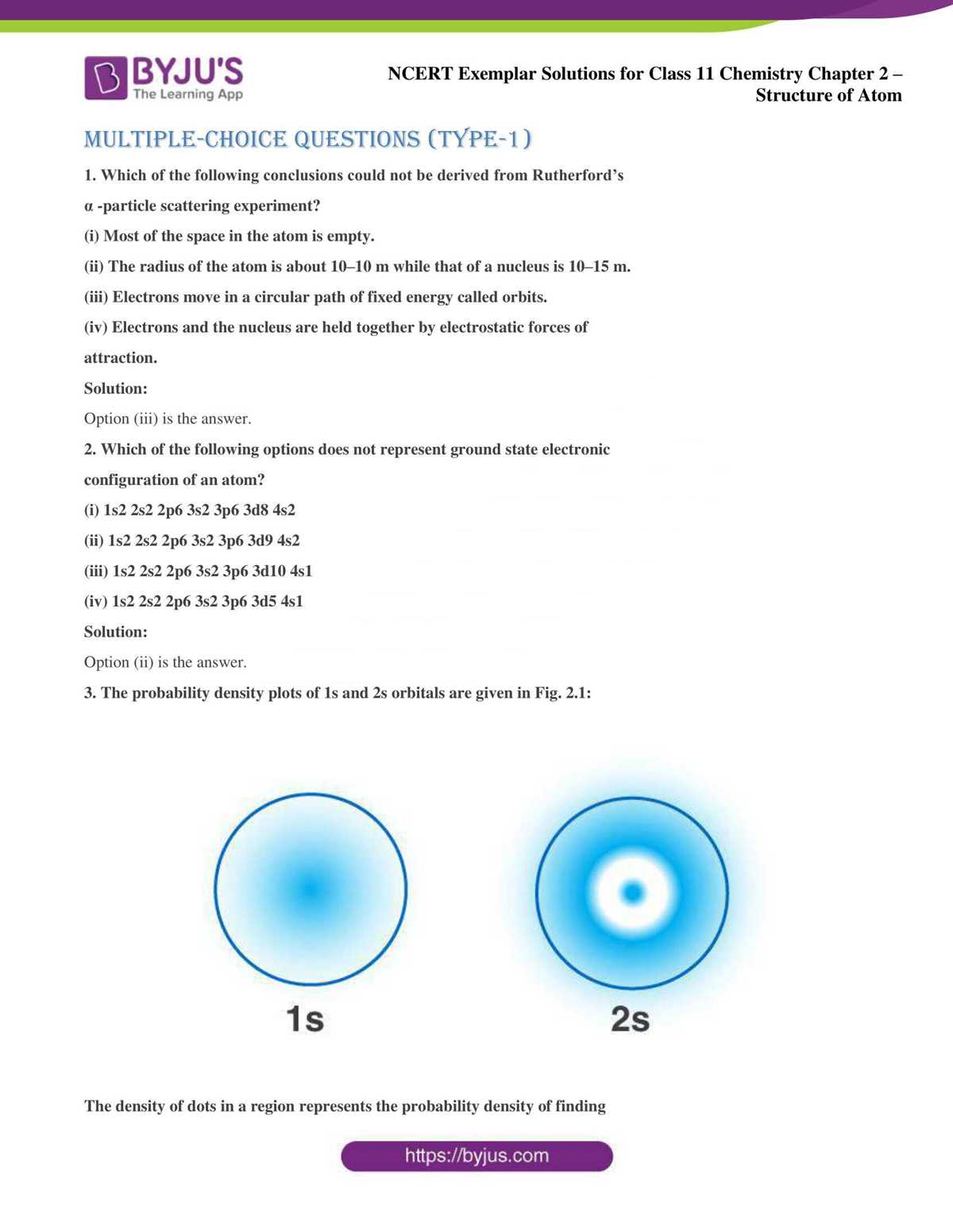
To improve your understanding of subatomic particles and their behaviors, start by focusing on key concepts like electron configurations and quantum numbers. A solid grasp of these ideas will allow you to tackle a variety of related exercises with confidence. Begin by practicing with simple tasks, then move on to more complex scenarios involving isotopes and electron transitions.
Understanding the periodic table is critical for solving related questions. Focus on how elements are arranged by atomic number and how periodic trends like electronegativity or ionization energy play into these exercises. Reviewing periodic trends will also help clarify questions related to element properties and their interactions.
When solving these types of exercises, be sure to pay close attention to the placement of electrons in orbitals and the implications of their movements. Understanding quantum mechanics and the rules governing electron placement will improve accuracy when determining configurations or predicting an atom’s behavior under different conditions.
Atomic Structure Practice Problems Answer Key
For electron configuration questions, remember that each element’s configuration follows the Aufbau principle, where electrons fill orbitals starting with the lowest energy level. For example, the configuration of oxygen (atomic number 8) is 1s² 2s² 2p⁴. Double-check the placement of electrons in each shell to ensure accuracy.
For determining the atomic number and mass number, the atomic number is simply the number of protons in the nucleus, while the mass number is the sum of protons and neutrons. For instance, the element carbon has an atomic number of 6 and a mass number of 12, as it has 6 protons and 6 neutrons.
In questions about isotopes, identify the element by its atomic number and then adjust the number of neutrons. For example, carbon-14 has the same atomic number (6) as carbon-12, but it has 8 neutrons instead of 6. Isotopes of the same element share the same chemical properties but differ in their mass.
When asked to identify trends in the periodic table, focus on how properties like electronegativity and atomic radius change across periods and groups. Electronegativity increases across a period from left to right, while atomic radius decreases across the same period due to increasing nuclear charge pulling electrons closer to the nucleus.
For quantum number questions, make sure to assign the correct values to each quantum number:
- n (principal quantum number) determines the energy level
- l (azimuthal quantum number) defines the shape of the orbital
- mₗ (magnetic quantum number) specifies the orientation of the orbital
- mₛ (spin quantum number) indicates the direction of electron spin
For example, the quantum numbers for an electron in the 3p orbital of phosphorus (atomic number 15) would be n=3, l=1, mₗ=-1, mₛ=+1/2.
Understanding Atomic Models Through Practice Problems
To fully grasp the behavior of subatomic particles, focus on understanding key atomic models like Dalton’s, Thomson’s, Rutherford’s, and Bohr’s. Begin with simple exercises that help you identify the key features of each model. For example, Dalton’s model emphasizes indivisible atoms, while Rutherford’s model introduces the nucleus and electron cloud.
Use problems to test your understanding of how electrons are arranged in an atom. For example, in Bohr’s model, electrons occupy fixed orbits around the nucleus. Practice by determining the energy levels of various atoms, such as calculating the energy difference between two orbits in hydrogen.
Compare the models to determine their strengths and weaknesses. Rutherford’s model, for example, showed that atoms have a dense, positively charged nucleus, but could not explain the stability of electron orbits. Bohr’s model solved this by introducing quantized energy levels, but later models, such as the quantum mechanical model, refined our understanding of electron behavior further.
| Model | Key Features | Strengths | Limitations |
|---|---|---|---|
| Dalton | Atoms are indivisible | First theory of matter | Does not explain isotopes or subatomic particles |
| Thomson | Plum pudding model | Introduced electrons | Failed to explain atomic structure accurately |
| Rutherford | Positive nucleus with electron cloud | Discovered the nucleus | Could not explain electron stability |
| Bohr | Electrons in fixed orbits | Explained hydrogen atom spectrum | Does not work for atoms with more than one electron |
| Quantum Mechanical | Electron clouds, probabilistic orbits | Most accurate model today | Complex and difficult to visualize |
How to Solve Electron Configuration Problems
Begin by identifying the element’s atomic number, which corresponds to the number of electrons. Use this number to determine the electron configuration by filling orbitals according to the Aufbau principle. Start with the lowest energy level and move to higher levels, following the order: 1s, 2s, 2p, 3s, 3p, 4s, 3d, 4p, 5s, 4d, 5p, and so on.
Apply the Pauli Exclusion Principle and Hund’s Rule as you fill the orbitals. The Pauli Exclusion Principle states that no two electrons in the same atom can have the same set of quantum numbers, meaning each orbital can hold a maximum of two electrons with opposite spins. Hund’s Rule indicates that electrons will occupy degenerate orbitals (orbitals of the same energy level) singly before pairing up.
For elements with higher atomic numbers, be aware of exceptions to the general filling order. Transition metals and lanthanides may have electron configurations that differ slightly due to the stability gained by having filled or half-filled d or f subshells. For example, chromium (Cr) has the configuration [Ar] 4s¹ 3d⁵ instead of [Ar] 4s² 3d⁴ due to the extra stability of a half-filled d subshell.
Double-check your configuration by counting the total number of electrons in the orbitals to ensure it matches the atomic number. For example, nitrogen (atomic number 7) has the configuration 1s² 2s² 2p³, with a total of 7 electrons.
Mastering the Periodic Table Trends with Examples
Focus on understanding periodic trends such as atomic radius, electronegativity, ionization energy, and electron affinity. These trends help predict element behaviors and interactions. For example, atomic radius decreases across a period from left to right due to increasing nuclear charge pulling electrons closer, while it increases down a group as additional electron shells are added.
Electronegativity increases across a period and decreases down a group. Fluorine (F) has the highest electronegativity because it has a small atomic radius and a high nuclear charge, making it very effective at attracting electrons in chemical bonds. In contrast, cesium (Cs), located at the bottom of Group 1, has low electronegativity due to its large atomic radius and low effective nuclear charge.
Ionization energy increases across a period as atoms hold onto their electrons more tightly due to greater nuclear charge, while it decreases down a group. For instance, ionization energy is highest for helium (He), which has a small size and strong attraction between the nucleus and electrons. Conversely, potassium (K) has a much lower ionization energy due to its larger atomic radius and weaker hold on its outer electron.
For further details on periodic trends, refer to authoritative sources such as the ChemBlink website, which provides up-to-date information on chemical properties and trends across elements.
Common Mistakes in Atomic Structure Exercises and How to Fix Them
One frequent mistake is incorrectly filling electron orbitals. Follow the correct order of orbitals: 1s, 2s, 2p, 3s, 3p, 4s, 3d, 4p, and so on. Ensure that you respect the Aufbau principle, the Pauli Exclusion Principle, and Hund’s Rule. For example, in the case of oxygen (atomic number 8), its configuration should be 1s² 2s² 2p⁴, not 1s² 2s² 2p³, which would be an incomplete configuration.
Another common error occurs when determining the number of protons, neutrons, and electrons. The number of protons is equal to the atomic number. The number of electrons in a neutral atom is the same as the atomic number. To find the number of neutrons, subtract the atomic number from the mass number. For instance, for carbon-12 (mass number 12), there are 6 neutrons (12 – 6 = 6).
Students also often confuse electron configurations with valence electron counting. Ensure that you are correctly identifying the number of valence electrons based on the outermost shell of an element. For example, sodium (Na) has an electron configuration of 1s² 2s² 2p⁶ 3s¹, so it has one valence electron in the 3s orbital, which is key when determining its chemical reactivity.
Lastly, remember that ionization energy increases across a period and decreases down a group. A common mistake is misunderstanding this trend and incorrectly predicting which elements have higher ionization energies. For example, sodium (Na) will have a lower ionization energy than chlorine (Cl), because chlorine’s electrons are more tightly bound due to a smaller atomic radius.
Step-by-Step Guide to Interpreting Atomic Number and Mass Number
To interpret the atomic number, look at the element’s position on the periodic table. The atomic number represents the number of protons in the nucleus of an atom. For example, hydrogen has an atomic number of 1, indicating it has 1 proton. The atomic number also equals the number of electrons in a neutral atom.
Next, to determine the mass number, add the number of protons and neutrons in the nucleus. For example, carbon-12 has 6 protons and 6 neutrons, so its mass number is 12. The mass number helps identify the isotope of an element. Isotopes of the same element have the same atomic number but different mass numbers due to variations in neutron count.
Remember that the mass number is not always a whole number on the periodic table because it represents the weighted average of all isotopes of an element. For instance, chlorine has an atomic number of 17 and an average atomic mass of 35.45, which reflects the mixture of chlorine-35 and chlorine-37 isotopes.
To find the number of neutrons in an isotope, subtract the atomic number from the mass number. For example, if you are working with chlorine-37 (mass number 37), subtract 17 (atomic number) from 37. This gives you 20 neutrons in chlorine-37.
Using Isotopes to Solve Atomic Structure Problems
To solve issues involving isotopes, first identify the element’s atomic number, which represents the number of protons. Then, focus on the mass number, which is the sum of protons and neutrons. For example, in carbon-14, the atomic number is 6, and the mass number is 14, meaning there are 8 neutrons (14 – 6 = 8).
Next, understand that isotopes of the same element have the same number of protons but differ in their neutron count. This difference affects the mass number. For example, carbon-12 has 6 neutrons, while carbon-14 has 8. These isotopes have nearly identical chemical properties but different physical properties due to the differing number of neutrons.
To calculate the number of neutrons in an isotope, subtract the atomic number from the mass number. For example, for oxygen-18, which has a mass number of 18 and an atomic number of 8, there are 10 neutrons (18 – 8 = 10). Use this method for any isotope to determine the neutron count.
When working with isotopes in problems, ensure you understand how their varying neutron counts affect calculations like average atomic mass. The average atomic mass of an element is the weighted average of all its isotopes. For example, chlorine has two main isotopes, chlorine-35 and chlorine-37. Their relative abundances influence the average atomic mass used in problems.
How to Approach Quantum Numbers in Atomic Practice Questions
To determine quantum numbers, start by identifying the electron’s energy level, which is represented by the principal quantum number (n). This number indicates the shell where the electron resides. For example, for an electron in the 3rd shell, n = 3.
Next, identify the angular momentum quantum number (l), which defines the subshell shape. The value of l ranges from 0 to n-1. For example, if n = 3, l can be 0, 1, or 2, corresponding to the s, p, and d subshells, respectively.
The magnetic quantum number (mₗ) specifies the orientation of the subshell in space. It can take values between -l and +l, including 0. For instance, if l = 2 (d subshell), mₗ can range from -2 to +2.
Finally, the spin quantum number (mₛ) describes the direction of the electron’s spin. It can only be +1/2 or -1/2. For example, in a paired electron configuration, one electron will have mₛ = +1/2, and the other will have mₛ = -1/2.
To practice, work through questions step by step, using the rules above to determine each quantum number. Remember that the quantum numbers must satisfy the Pauli Exclusion Principle, meaning no two electrons in the same atom can have the same set of all four quantum numbers.
Testing Your Knowledge with Realistic Atomic Structure Scenarios
To test your understanding, create scenarios based on different elements and their isotopes. For example, consider a scenario with chlorine-35 and chlorine-37. Calculate the number of protons, neutrons, and electrons in each isotope. Ensure you identify the differences in mass number and isotope notation.
Another practical scenario involves determining electron configuration for elements across different periods. For instance, ask yourself how the electron configuration for calcium (Ca) differs from that of potassium (K), and identify the trends in filling orbitals as you move across the periodic table.
Use real-world examples to understand how isotopes are used in medicine or carbon dating. This type of scenario will help you connect theoretical knowledge with practical applications. For example, the use of carbon-14 in dating ancient artifacts requires you to calculate the remaining amount of carbon-14 after a certain period.
Additionally, practice solving questions about quantum numbers for various elements. For example, if given the element nitrogen (N), identify its quantum numbers based on the electron configuration. Work through such examples step by step, ensuring you understand how each quantum number relates to the position and behavior of the electron.