Simple Machines Worksheet Solutions with Explanations
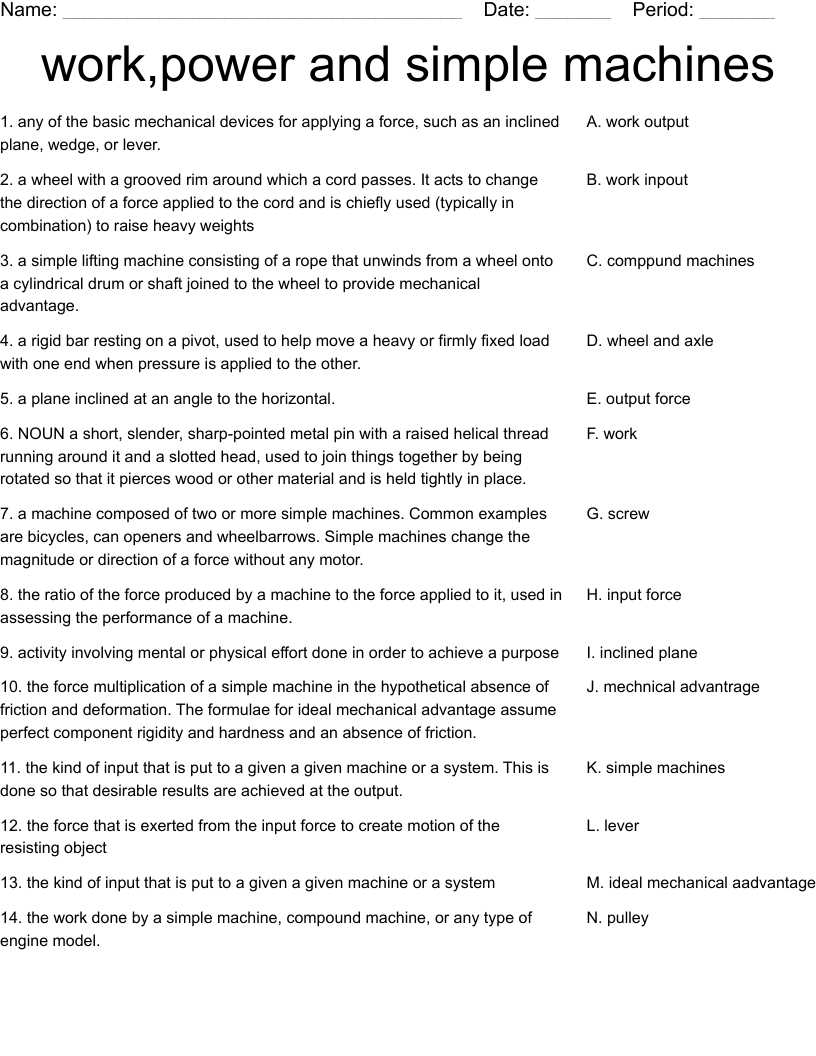
To solve problems related to basic mechanical systems, begin by understanding the fundamental concepts behind levers, pulleys, inclined planes, and other basic devices. These tools allow you to apply force in different ways, making work easier by changing direction or amount of force required.
Start by recognizing the different types of levers: first class, second class, and third class. Each type offers a unique way of amplifying or changing force. For example, a crowbar is a first-class lever that provides a mechanical advantage by using a fulcrum placed between the force and the load.
Next, practice calculating the mechanical advantage of pulley systems. By understanding how pulleys reduce the effort needed to lift heavy loads, you can apply this principle to real-world scenarios like lifting objects or transporting materials more efficiently.
Inclined planes are another vital concept. They make work easier by allowing you to move heavy objects upward with less force. By calculating the slope of an inclined plane, you can determine how much effort is required to lift a given object.
With each device, focus on the relationship between force, distance, and mechanical advantage. This knowledge is key to understanding how these systems can be used effectively in everyday applications.
Simple Machines Solutions
To calculate the mechanical advantage of a lever, use the formula: Mechanical Advantage (MA) = Distance from fulcrum to effort / Distance from fulcrum to load. For a first-class lever, the fulcrum is located between the effort and the load, so adjust your measurements accordingly. For instance, in a crowbar, if the fulcrum is 1 meter from the load and 2 meters from the effort, the MA is 2.
For pulley systems, the MA is determined by counting the number of rope sections supporting the load. A fixed pulley has an MA of 1, as it only changes the direction of the applied force. A movable pulley, on the other hand, increases MA by 2 or more, depending on the setup. For example, if you have two segments of rope lifting a load, the MA is 2.
Inclined planes require calculating the ratio of the length of the incline to its height. This gives the mechanical advantage. If the ramp is 5 meters long and 1 meter high, the MA is 5. This means you are using less force to lift the object, but over a greater distance.
In a wheel and axle setup, calculate the MA by dividing the radius of the wheel by the radius of the axle. If the wheel radius is 4 meters and the axle radius is 1 meter, the MA is 4. This means the force is amplified by a factor of 4 when using the wheel to turn the axle.
By applying these formulas, you can determine the mechanical advantage for each device, helping you understand how force is distributed and the effort required to perform work in different situations.
Understanding the Concept of Simple Machines
To understand mechanical advantage, focus on how each tool reduces the effort required to perform work. These tools leverage force in different ways, providing greater output with less input. There are six primary types of these devices, each serving a specific purpose:
- Lever: A rigid bar that pivots around a point, the fulcrum. Depending on where the load and effort are placed, it can magnify force or distance.
- Pulley: A wheel with a groove for a rope or cable. It can change the direction of the force or multiply the force, depending on the setup.
- Inclined Plane: A slanted surface used to lift objects by applying less force over a longer distance.
- Wheel and Axle: A wheel attached to a central axle, this system amplifies force by allowing a larger input force applied to the wheel to turn a smaller axle with greater speed.
- Wedge: A piece of material that tapers to a point, used to split, cut, or pry objects apart. It converts a force applied at a wide angle into a concentrated force.
- Screw: An inclined plane wrapped around a central shaft. It can hold objects together or raise materials with a turning motion.
Each of these tools is designed to make tasks easier by redistributing force, either by increasing the force applied, changing its direction, or spreading it over a longer distance. To fully grasp their use, consider how these tools are applied in real-world situations, such as using a crowbar to lift a heavy object or a pulley system to move a load upward with less force.
How Levers Work in Different Applications
Levers provide a mechanical advantage by using a rigid bar that pivots around a fixed point called the fulcrum. Depending on the position of the load, effort, and fulcrum, levers can amplify force or increase the distance over which a force is applied. The three classes of levers–first class, second class, and third class–differ in how the components are arranged, leading to different practical uses.
- First Class Lever: In this configuration, the fulcrum is between the effort and the load. This type is commonly used to change the direction of force, as seen in seesaws or crowbars, where a small force at one end lifts a larger load at the other.
- Second Class Lever: Here, the load is between the effort and the fulcrum. This design is used to increase force. An example is a wheelbarrow, where the effort applied at the handles allows a small force to lift a heavy load with minimal effort.
- Third Class Lever: The effort is positioned between the fulcrum and the load. This arrangement is used to increase the distance or speed of the output. A common example is a fishing rod, where the hand provides the effort near the handle, and the hook moves over a greater distance.
By understanding these variations, levers can be applied in different contexts to either reduce the force needed to perform a task or increase the distance over which a task is performed. For example, in construction, levers are often used in lifting and prying, while in sports, a lever system can increase the range of motion in activities like rowing or batting. The design and application of levers depend on the specific needs of the task, whether it’s maximizing force or movement speed.
Calculating Mechanical Advantage of Pulley Systems
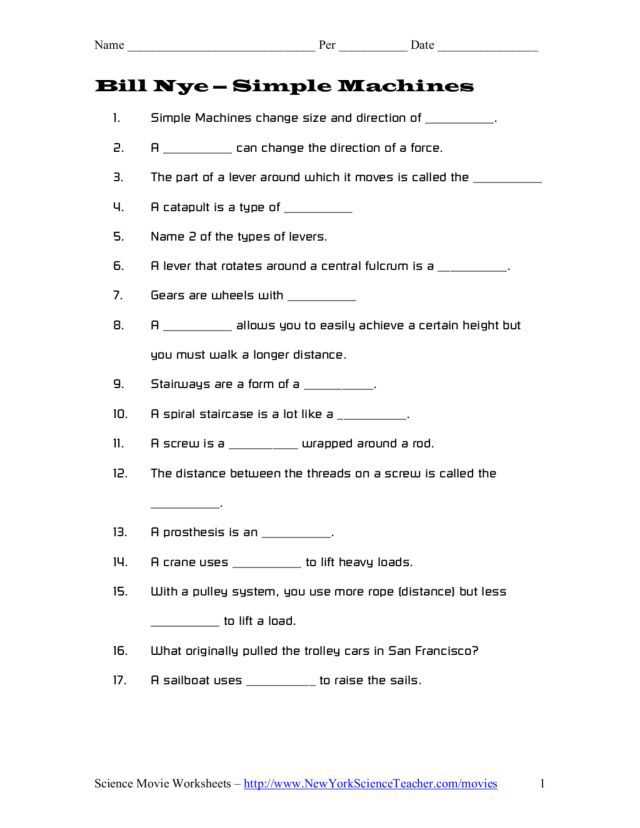
The mechanical advantage (MA) of a pulley system is a measure of how much the system amplifies the force applied to lift an object. To calculate MA, the formula depends on the type of pulley system used. There are two main categories: fixed pulleys and movable pulleys. Additionally, a combination of pulleys can be used in a block and tackle system to further increase mechanical advantage.
For a single fixed pulley, the mechanical advantage is 1. This means that the force required to lift the load is equal to the weight of the object. However, the direction of force changes, which can be useful in some applications like cranes or flagpoles.
For a single movable pulley, the mechanical advantage is 2. In this case, the pulley itself moves with the load, effectively halving the force needed to lift the object. The force required is reduced, but the distance over which the force is applied is doubled.
For a block and tackle system, which is a combination of fixed and movable pulleys, the mechanical advantage is determined by counting the number of rope segments supporting the load. The more segments, the higher the mechanical advantage. To calculate the MA in this case:
- Mechanical Advantage (MA) = Number of supporting rope segments
For example, a system with four rope segments will provide a mechanical advantage of 4, meaning the force required to lift the object is one-fourth of the load’s weight. However, the distance over which you apply the force will be four times the distance the load is lifted.
It’s important to note that while a pulley system reduces the amount of force needed, it doesn’t reduce the amount of work required to lift the object. The work (force x distance) remains the same, but the system helps redistribute the force applied, making lifting tasks easier.
Inclined Planes and Their Role in Reducing Effort
An inclined plane reduces the amount of force needed to lift an object by increasing the distance over which the force is applied. The mechanical advantage of an inclined plane can be calculated by comparing the length of the slope to its height. The greater the length of the inclined surface, the less force is required to move an object upward.
To calculate the mechanical advantage (MA) of an inclined plane, use the formula:
- MA = Length of incline / Height of incline
For example, if the length of the inclined plane is 10 meters and the height is 2 meters, the mechanical advantage is:
- MA = 10 / 2 = 5
This means that the force required to move the object is reduced by a factor of 5. However, the distance traveled along the incline is 5 times longer than lifting the object vertically. In practice, this makes tasks like loading heavy objects onto trucks or ramps much easier by reducing the force needed.
In addition to reducing the effort needed to lift objects, inclined planes are also more efficient in terms of time. Using a longer slope, for example, allows workers to move heavy loads with less exertion, even though the total distance covered is greater. In essence, inclined planes redistribute the effort over a longer distance, making lifting more manageable.
Explaining the Function of Wheel and Axle
The wheel and axle system reduces the amount of force needed to move an object by converting rotational motion into linear motion. The wheel acts as a larger diameter surface that applies force over a greater distance, while the axle provides the rotation that moves the object.
Mechanical advantage (MA) in a wheel and axle system is calculated by comparing the radius of the wheel to the radius of the axle. The formula is:
- MA = Radius of wheel / Radius of axle
For example, if the wheel has a radius of 6 cm and the axle has a radius of 2 cm, the mechanical advantage is:
- MA = 6 / 2 = 3
This means that the force applied to the wheel is reduced by a factor of 3, making it easier to move the object. The system allows the user to apply less force, but over a greater distance, which results in more efficient movement, especially for heavy loads.
Common examples of wheel and axle systems include doorknobs, rolling carts, and vehicles. The axle transfers the force from the wheel to the object, and the wheel allows it to move over a surface with minimal resistance. The larger the wheel and the smaller the axle, the greater the mechanical advantage, allowing for easier movement of heavy objects.
Determining Work Done with Simple Machines
To calculate the work done using mechanical devices, use the formula for work:
| Work (W) = Force (F) × Distance (d) |
Work is measured in joules (J), force in newtons (N), and distance in meters (m). The force applied on an object and the distance over which it is moved are crucial factors in determining how much work is done.
When using mechanical systems such as pulleys, levers, or inclined planes, the amount of work done remains constant, but the way force is applied may change. For example, in a lever system, force is applied over a shorter distance to move an object a longer distance. This means you exert less force, but the same amount of work is done because the distance is greater. However, efficiency in these devices is impacted by friction, which may cause some energy loss.
Here’s an example:
| Force Applied | Distance Moved | Work Done |
|---|---|---|
| 10 N | 5 m | 50 J |
In this case, applying a force of 10 newtons over a distance of 5 meters results in 50 joules of work done.
For more detailed explanations and formulas on work in mechanical systems, visit The Physics Classroom.
Real-Life Examples of Simple Machines in Action
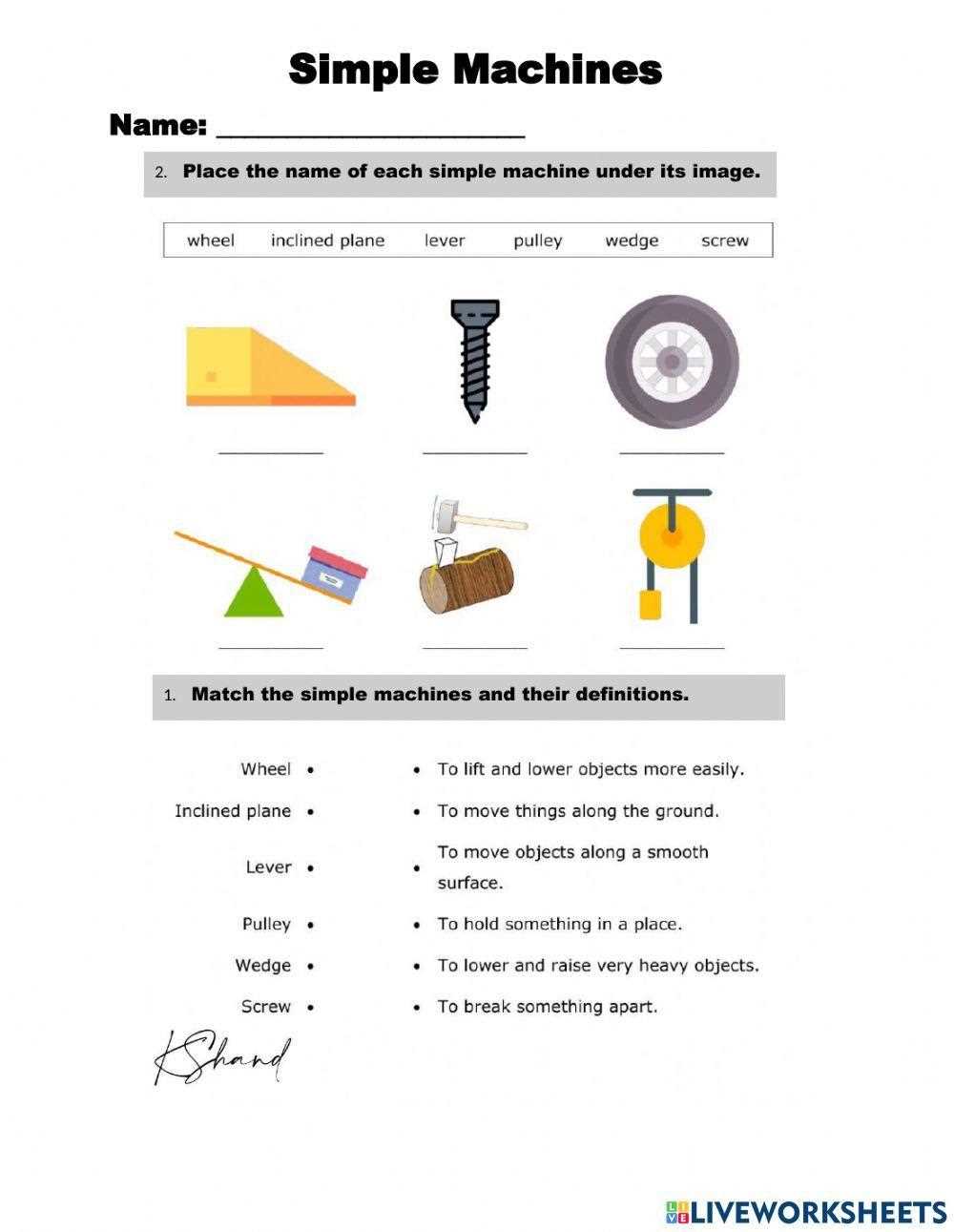
One of the most common real-life applications of an inclined plane is the ramp used in construction sites. Ramps reduce the effort needed to lift heavy materials by spreading the load over a longer distance. By increasing the distance, the required force to move the object is reduced, making it easier to transport goods up or down.
Another example can be found in bicycle gears. The gear system acts as a wheel and axle, allowing cyclists to adjust the amount of force needed to pedal at different speeds or terrains. This helps in achieving mechanical advantage by changing the size of the gears and the force exerted on the pedals.
A crowbar is a classic example of a lever used to pry open doors or lift heavy objects. By applying force at one end of the crowbar, a small effort is enough to move a large load, thanks to the leverage provided by the bar’s fulcrum.
Scissors demonstrate the use of two levers working in tandem. Each arm of the scissors operates like a lever, cutting through materials by reducing the force needed through mechanical advantage. The pivot point (fulcrum) allows for greater control and force multiplication when cutting.
Lastly, a pulley system in a flagpole helps raise and lower a flag with minimal effort. By changing the direction of the applied force, pulleys make it easier to lift objects vertically by providing a mechanical advantage, allowing you to pull downward to lift a heavy load upwards.
Common Mistakes in Simple Machine Calculations
A frequent mistake in calculating mechanical advantage is neglecting to account for the friction in a system. Friction reduces the efficiency of a setup, and its effect should be subtracted from the ideal mechanical advantage for more accurate results.
Another error is failing to correctly identify the input and output forces when using levers or pulleys. Misunderstanding which force is being applied and which force is being moved can lead to incorrect calculations and confusion about the system’s effectiveness.
When calculating the work done by a system, many mistakenly assume that the input distance is the same as the output distance. In many cases, the output distance may be altered depending on the configuration of the system, which can change the required force and the work done.
Also, errors often arise when people forget to use consistent units for force, distance, or work. Mixing up units such as newtons and kilograms can lead to incorrect calculations, as proper unit conversions are essential for obtaining accurate results.
Finally, one of the most common mistakes is overlooking the direction of force. In calculating the mechanical advantage of a pulley or inclined plane, it is vital to recognize the direction in which the force is applied and the force that is being displaced to ensure accuracy in the result.