Understanding Domain and Range with Practical Examples
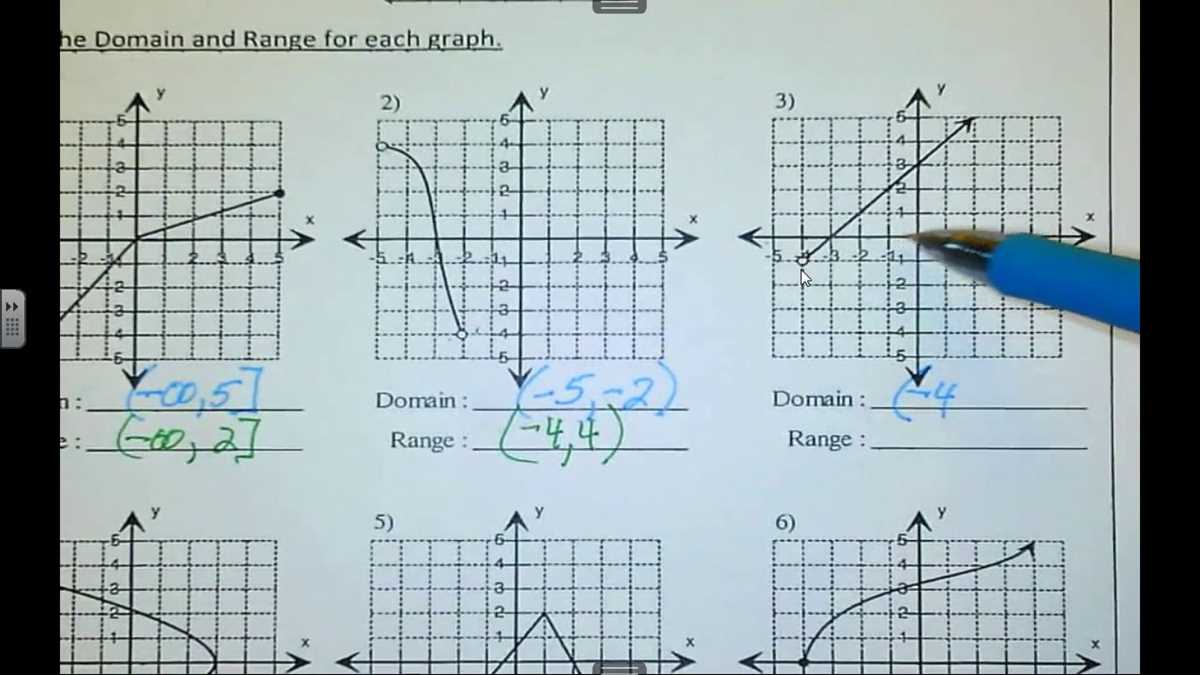
To correctly solve for valid inputs and corresponding outputs in mathematical functions, start by analyzing the types of numbers that can be substituted into the equation. For many types of functions, certain values will result in invalid or undefined outcomes. For example, dividing by zero or taking the square root of a negative number may lead to issues.
Once you have identified potential restrictions on inputs, you can focus on the set of valid values. These are the numbers that can be used without violating the function’s rules. Next, determine how the outputs are shaped by these inputs. This helps to map the possible results, whether they are bounded or unbounded, and ensures that no possible result is overlooked.
Using these steps consistently will help you solve problems related to valid inputs and corresponding outputs across various types of functions. Pay attention to both the algebraic restrictions and graphical representations to avoid common pitfalls when solving these kinds of problems.
Understanding the Inputs and Outputs of Functions
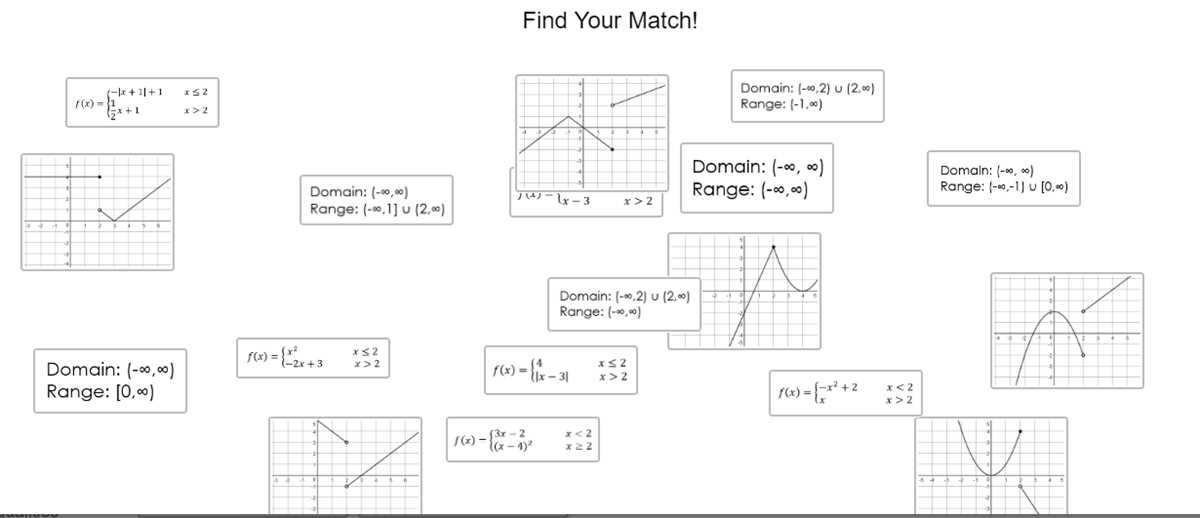
To determine the valid inputs for a function, first identify any restrictions. For example, if the function involves division, check for values where the denominator equals zero, as these are undefined. Similarly, for functions involving square roots or logarithms, ensure the values inside the radical or logarithmic expression are non-negative and positive, respectively.
Once the valid inputs are established, focus on determining the corresponding outputs. Depending on the function, the outputs may be limited or unbounded. For polynomial functions, the outputs typically span all real numbers, while trigonometric functions might have periodic outputs, often constrained within specific intervals.
Graphically, the inputs correspond to the x-axis values, and the outputs to the y-axis values. A clear understanding of these relationships allows for accurate interpretation of the function’s behavior across its entire set of possible inputs.
Understanding the Concept of Valid Inputs in Functions
To identify valid inputs for a function, start by recognizing which values can be used without causing errors. For rational expressions, avoid values that would make the denominator zero. For square roots, ensure that the number inside the root is non-negative. Similarly, for logarithmic functions, ensure that the input is positive, as logarithms of non-positive numbers are undefined.
Check for any other restrictions based on the function’s structure. For example, in piecewise functions, the valid inputs are often restricted to certain intervals. Be sure to identify the specific conditions under which the function is defined.
Graphically, the valid inputs are represented by the x-values that lead to real, defined outputs. Always assess these restrictions before solving the function to ensure that you’re working within its defined limits.
How to Identify the Output Set of a Function
To find the output set of a function, start by analyzing the function’s behavior based on its type. For polynomial functions, the output set usually includes all real numbers unless there are specific restrictions (such as for square roots or logarithmic functions).
For rational functions, check the potential limits that the output can approach. This may involve analyzing the function as the input approaches specific values, particularly where the function is undefined or has asymptotes. Pay attention to horizontal or vertical asymptotes that might limit the set of outputs.
In the case of square roots or even roots, the output set will only include non-negative numbers, as the square root of a negative number is not defined in the real number system. Similarly, for logarithmic functions, the output set will depend on the range of possible logarithmic values.
For piecewise functions, evaluate the output for each piece separately, and identify the collective set of all possible values. Graphically, the output set is represented by the y-values that the graph reaches.
By considering the above factors, you can accurately determine the output set of a function and identify its limitations based on its algebraic structure.
Common Mistakes When Determining Output Set and Input Set
One common mistake is assuming that all real numbers are valid inputs without considering any restrictions. For example, functions with denominators or square roots must be carefully analyzed to avoid undefined values.
Another frequent error is overlooking vertical asymptotes in rational functions. These asymptotes create gaps in the input set, and ignoring them can lead to incorrect conclusions about valid inputs.
In functions involving square roots, it’s essential to remember that only non-negative values are acceptable for the inputs. Failing to restrict the input values to the proper domain can lead to invalid solutions.
When dealing with logarithmic functions, many overlook that the input must always be greater than zero. This is a crucial aspect that affects the allowable values for the input, and neglecting it can result in incorrect interpretations.
Another mistake occurs when dealing with piecewise functions. Each piece of the function might have different restrictions on the input and output, and it’s vital to check each segment separately to avoid combining invalid intervals.
Lastly, some may mistake the output set as including only the values explicitly shown in a table or graph. However, the output set should consider all possible values that the function can approach, including those from limits or asymptotic behavior.
Determining Output Set and Input Set from Graphs
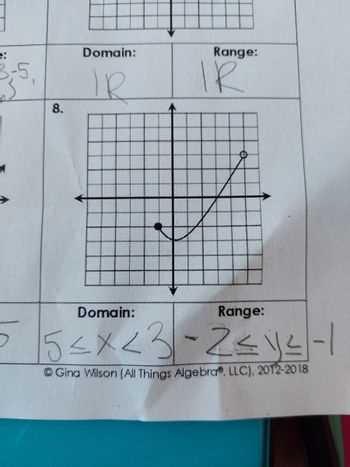
To find the input set from a graph, identify all the possible x-values where the curve exists. Exclude any regions where the function does not extend, such as gaps or vertical asymptotes. For example, if the graph is undefined at x = 2, this value is excluded from the input set.
For functions with a limited domain, look for endpoints or intervals where the graph starts or ends. These boundaries indicate the valid x-values. A graph that ends at a specific x-value suggests that the input set is constrained within that interval.
When determining the output set, focus on the y-values that the graph reaches. Observe the highest and lowest points the graph attains. Pay attention to whether the function approaches but never reaches certain values (horizontal asymptotes), as these might indicate the outer bounds of the output set.
If the graph is continuous and spans infinitely in the vertical direction, the output set may be unbounded. Check for behavior at both ends of the graph: if the curve rises or falls without bound, the output set will include positive or negative infinity, respectively.
For piecewise functions, each segment of the graph must be analyzed separately. Identify the intervals of validity and the corresponding y-values for each piece. This is crucial in determining the overall output set.
When encountering a graph with a sharp turn or corner, it may indicate a restricted input set or output set. Check whether the graph skips over certain values or includes them only at specific points.
Using Set Notation for Input and Output Sets
To represent an input set, use set notation by enclosing the valid x-values in curly braces. For example, if the function is valid for x-values between -2 and 3, the set notation would be written as x .
If there are specific values excluded from the input set, such as discontinuities or undefined points, represent this using interval notation. For example, if the function is undefined at x = 1, the set notation would be x ≠ 1 for the input set excluding x = 1.
For output sets, list all the possible y-values the function can reach. If the output spans an interval, express this using interval notation as well. For example, if the function’s output is between -5 and 2, it would be written as -5 ≤ y ≤ 2.
When dealing with infinite sets, indicate unbounded values with infinity. For example, if the output increases without bound, the output set would be written as y , or for decreasing outputs, y ≤ 0.
For piecewise functions, each segment of the input-output relationship must be expressed separately. For example, if the function is defined as f(x) = x for x in the interval [1, 5], and f(x) = 2x for x in the interval (5, ∞), represent this with two separate sets: 1 ≤ x ≤ 5 for the first part and x for the second part.
When the set includes all real numbers within a specific condition, use the universal set notation. For example, the input set for all real numbers could be represented as x , where ℝ denotes the set of all real numbers.
Finding Valid Input and Output in Rational Functions
In a rational function, the input values that result in a zero denominator must be excluded from the valid input set. To find these values, set the denominator equal to zero and solve for x. For example, for the function f(x) = 1/(x-2), the denominator is zero when x = 2. Therefore, x = 2 is excluded from the input set.
For determining the valid output values, analyze the behavior of the function. If the function has vertical asymptotes or other restrictions, these will affect the possible outputs. In the example f(x) = 1/(x-2), the function approaches infinity as x approaches 2, but never actually reaches it. This means the output can approach but never include infinity.
To determine the output limits more precisely, consider the function’s asymptotes. Horizontal asymptotes indicate a limit to the possible output values as x approaches positive or negative infinity. For example, in the function f(x) = 1/x, the horizontal asymptote is y = 0, meaning the function never reaches a value of 0, but gets infinitely close to it.
If the rational function is composed of a numerator and denominator with no common factors, check if the function is defined for all real numbers except for the values that make the denominator zero. This will often result in an input set that excludes one or more values.
When the function has a factorable denominator, such as f(x) = (x+1)/(x^2-1), first factor the denominator to find values that make it zero. In this case, x^2 – 1 factors to (x+1)(x-1), so x = -1 and x = 1 must be excluded from the input set.
Special Cases: Input and Output in Square Roots and Logarithmic Functions
For square root functions, the expression inside the radical must be greater than or equal to zero. For example, in the function f(x) = √(x-3), the expression x-3 must be ≥ 0. Therefore, the valid input values are x ≥ 3. Any value less than 3 will result in an undefined output.
When considering the output of a square root function, the result is always non-negative. For the function f(x) = √(x-3), the possible output values are all non-negative real numbers. This means that y ≥ 0 for all valid inputs.
For logarithmic functions, the expression inside the logarithm must be greater than zero. For example, in the function f(x) = log(x-2), the expression x-2 must be > 0, so the valid input values are x > 2. The function is undefined for x ≤ 2.
In logarithmic functions, the output can be any real number. As x approaches the lower bound (from above), the output tends to negative infinity, while as x increases, the output increases without bound. For example, in f(x) = log(x-2), as x approaches 2 from the right, f(x) approaches negative infinity, and as x increases, f(x) increases.
- Square root: The input must be greater than or equal to zero; the output is always non-negative.
- Logarithmic: The input must be greater than zero; the output can be any real number.
Practical Examples: Solving Input and Output Problems
Consider the function f(x) = √(x – 4). To determine the valid input values, set the expression inside the square root greater than or equal to zero:
x – 4 ≥ 0 → x ≥ 4. Therefore, the input values must be greater than or equal to 4. The output will be all non-negative real numbers, since the square root of any non-negative number is non-negative.
Now consider the function f(x) = log(x + 3). To determine valid input values, the expression inside the logarithm must be greater than zero:
x + 3 > 0 → x > -3. Therefore, the valid inputs are x > -3, and the output can be any real number. As x approaches -3 from the right, the output approaches negative infinity. As x increases, the output increases without bound.
- For f(x) = √(x – 4), valid inputs: x ≥ 4, valid outputs: y ≥ 0.
- For f(x) = log(x + 3), valid inputs: x > -3, valid outputs: all real numbers.
For more detailed examples and practice, refer to the resources available on Khan Academy.