Describing Motion Worksheet Answer Key with Step-by-Step Solutions
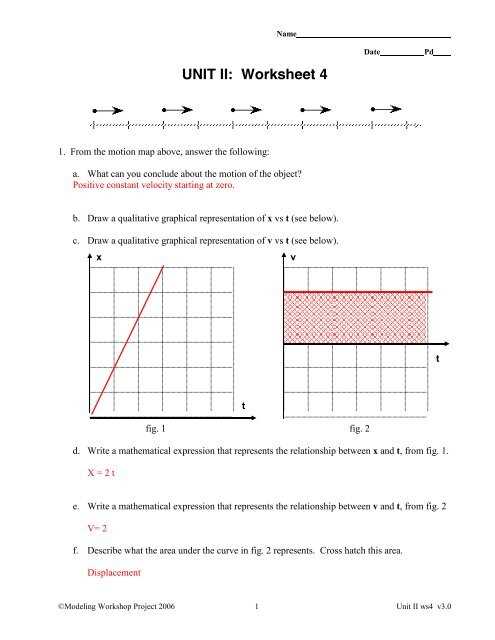
If you’re working through exercises on the movement of objects, the first step is always to identify the given variables: distance, time, and speed. Once you have these, you can apply basic equations to find unknown values. For instance, if you’re given the distance an object travels and the time it takes, calculating the speed becomes a straightforward task. The formula speed = distance / time will give you the answer in units like meters per second (m/s).
Next, when velocity is involved, ensure you account for direction. Velocity differs from speed in that it has both magnitude and direction. In problems that involve changes in direction, you may need to break down the components of velocity using vectors. This is where understanding vector addition can help, especially when you encounter problems with objects moving at angles or in multiple directions.
If you’re dealing with acceleration, remember the core formula: acceleration = (final velocity – initial velocity) / time. Acceleration measures how quickly an object changes its velocity. In many problems, you’ll also need to apply this formula to solve for the final velocity or the time it takes for an object to reach a certain speed under constant acceleration.
It’s important to practice interpreting graphs and diagrams in these types of problems. A distance-time graph, for example, will show how far an object has traveled over time, and the slope of the graph will give you the speed. A velocity-time graph, on the other hand, can help you determine the acceleration, as the slope of the graph represents the rate of change of velocity.
Finally, always check the units you’re working with. Consistency is key. If the problem provides distance in kilometers and time in hours, make sure to convert them to standard units, like meters and seconds, to avoid errors in your calculations. By following these steps, you’ll be able to confidently solve problems related to the movement of objects.
Understanding Key Concepts in Motion Analysis
Start by focusing on the basic variables: distance, time, and speed. These three are the building blocks of nearly every problem related to an object’s travel. Distance measures how far something moves, time tracks how long it takes, and speed quantifies the rate at which an object moves. In simple problems, speed can be calculated using the formula speed = distance / time. Ensure that all units are consistent before performing calculations.
Next, velocity comes into play. Unlike speed, velocity accounts for both the rate of travel and direction. In problems where the direction is important, velocity is more useful than speed. For instance, if an object is moving in a circular path, its speed may remain constant, but its velocity changes as it moves. To calculate velocity, divide displacement (the straight-line distance between two points) by time.
Acceleration is another important concept. It refers to the rate at which an object’s velocity changes. If an object’s velocity increases or decreases over time, acceleration is involved. The formula for acceleration is acceleration = (final velocity – initial velocity) / time. In some problems, you might encounter constant acceleration, where the change in velocity happens at a uniform rate, making calculations straightforward.
Understanding graphs is also critical. Distance-time graphs, for example, show how far an object has traveled over time. The slope of the graph represents speed. For velocity-time graphs, the slope represents acceleration, and the area under the graph gives the total displacement. These visual tools help to interpret data more easily and are often used in problem-solving.
Finally, always convert units when necessary. Speed might be given in kilometers per hour, while distance might be in meters. Consistency in units, such as converting everything to SI units (meters, seconds), ensures accurate results. Properly applying these concepts to problems requires careful attention to detail and a solid understanding of the formulas at play.
How to Solve Problems Involving Object Movement Step-by-Step
To solve problems involving an object’s movement, follow these clear steps:
1. Identify Known Information: Start by noting all the given values in the problem, such as time, distance, speed, or velocity. Pay attention to units (meters, seconds, kilometers per hour) and convert them if needed for consistency.
2. Select the Correct Formula: Based on the variables you have, choose the appropriate equation. For example, use speed = distance / time if you are asked to find speed. For velocity, consider the direction and apply velocity = displacement / time.
3. Rearrange Equations if Necessary: If the problem asks for an unknown variable, rearrange the formula. For example, to find distance, use distance = speed × time if speed and time are known.
4. Plug Values into the Formula: Substitute the known values into the formula. Be careful with units to ensure consistency across all variables.
5. Solve for the Unknown: Perform the calculations carefully to find the unknown variable. Double-check your math to avoid errors.
6. Verify the Solution: Check if the result makes sense. For instance, if you calculated speed, ensure it is within a reasonable range for the scenario given in the problem. Review whether your units are correct and the direction matches the problem’s context.
Example Problem:
| Step | Action | Equation/Value |
|---|---|---|
| 1 | Identify known information | Distance = 100 m, Time = 20 s |
| 2 | Choose formula | Speed = distance / time |
| 3 | Substitute known values | Speed = 100 m / 20 s |
| 4 | Perform calculation | Speed = 5 m/s |
| 5 | Verify result | Speed of 5 m/s is reasonable |
Following this step-by-step method will help you solve these problems accurately and efficiently. For more detailed information and additional practice problems, refer to authoritative sources like The Physics Classroom.
Breaking Down the Units Used in Movement Descriptions
In problems involving object travel, using the correct units is crucial for accurate calculations and meaningful results. The most common units are derived from the International System of Units (SI).
Distance and Displacement: The standard unit for distance and displacement is the meter (m). Distance refers to the total path traveled, while displacement is the shortest straight-line distance between the starting and ending points. In some cases, distance may be given in kilometers (km) or centimeters (cm), but ensure you convert them to meters when necessary to maintain consistency.
Time: The unit for time is seconds (s). In some cases, time might be provided in minutes (min) or hours (h). To convert these to seconds, multiply minutes by 60 or hours by 3600. Consistency with time units ensures proper calculation of speed or velocity.
Speed and Velocity: Both speed and velocity are measured in meters per second (m/s) in the SI system. Speed is a scalar quantity (only magnitude), while velocity includes direction. If you encounter speed in other units, such as kilometers per hour (km/h), convert it to m/s by dividing by 3.6. This is important when solving for other quantities, such as acceleration.
Acceleration: The unit of acceleration is meters per second squared (m/s²). This measures how much the velocity changes per unit of time. If the problem provides initial and final velocities along with the time, you can calculate acceleration using the formula acceleration = (final velocity – initial velocity) / time.
Force: Force, when included in problems, is measured in newtons (N). A newton is defined as the force required to accelerate a 1 kg mass by 1 meter per second squared. In certain situations, you may need to use force to calculate other quantities like work or energy.
Energy and Work: The unit for energy and work is the joule (J), which is equivalent to a newton-meter. Work is calculated by multiplying force by distance in the direction of the force. When using units in work or energy calculations, be sure to verify that all components match the standard units of SI.
Understanding how to manipulate and convert these units will help you approach problems with confidence and precision. Always double-check your units before finalizing any calculations to avoid errors.
Interpreting Graphs and Diagrams in Movement Exercises
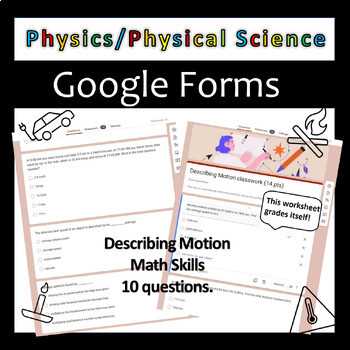
When analyzing graphs and diagrams, focus on identifying key features such as axes, slopes, and areas under curves. For distance-time graphs, the x-axis represents time, and the y-axis represents distance. The slope of the line indicates the speed. A steeper slope means a higher speed, while a horizontal line indicates no movement.
For velocity-time graphs, the x-axis still represents time, but the y-axis shows velocity. A horizontal line indicates constant velocity, while a sloped line represents acceleration. The area under the curve gives the displacement. For example, if the velocity-time graph shows a straight horizontal line, the area under it (which would be a rectangle) represents the distance traveled at that constant velocity.
Pay attention to the type of graph you’re dealing with. If the graph is non-linear, such as a curve instead of a straight line, the object’s speed or velocity is changing over time. In these cases, calculating the slope at various points can provide instantaneous speed or velocity. For curves, break the graph into smaller sections to approximate the slope at each point, if needed.
When interpreting position-time diagrams, the slope represents velocity. A curve indicates changing velocity, while a straight line indicates constant velocity. Negative slopes indicate motion in the opposite direction, and areas under a velocity-time graph can be used to find displacement over time.
Finally, ensure that the units are clearly understood. Distance is often in meters (m), time in seconds (s), and velocity in meters per second (m/s). Consistency in units is necessary to make accurate interpretations and solve related problems effectively.
Common Mistakes to Avoid in Movement Exercises
One frequent error is using incorrect units. Always ensure that distance is in meters, time in seconds, and speed or velocity in meters per second (m/s). Converting between units when needed is key to getting accurate results.
Another mistake is neglecting to account for direction when calculating velocity. Unlike speed, velocity involves both magnitude and direction. Failing to consider direction leads to incorrect conclusions about an object’s travel path.
Confusing displacement with distance is also common. Distance is the total path traveled, whereas displacement is the straight-line distance between two points. Ensure you understand the difference before applying formulas.
For problems involving acceleration, avoid assuming that acceleration is always constant unless the problem specifically states it. If acceleration is not constant, the motion is non-uniform, and different methods are needed to solve the problem.
Not interpreting graphs properly is another common mistake. A horizontal line on a distance-time graph indicates no movement, but some might incorrectly assume it represents constant motion. Similarly, the area under a velocity-time graph should be interpreted as displacement, not just speed.
Lastly, ensure the formulas used are correct for the type of problem you’re solving. Using the wrong formula can lead to incorrect calculations. For example, don’t use speed formulas when velocity or acceleration is involved.
How to Calculate Speed and Velocity in Movement Problems
To calculate speed or velocity, follow these specific steps:
- Identify known values: Determine the distance (or displacement), time, and any other relevant information provided in the problem. Distance is usually given in meters (m), and time in seconds (s).
- Use the correct formula:
- Speed: Speed = distance / time. Speed is a scalar quantity and only measures how fast an object moves, regardless of direction.
- Velocity: Velocity = displacement / time. Velocity includes both speed and direction, so it’s important to consider the direction in which the object is traveling.
- Ensure consistent units: Always use standard units. If distance is given in kilometers, convert it to meters (1 km = 1000 m). If time is in minutes, convert it to seconds (1 min = 60 s).
- Substitute values: Plug the known values into the formula and perform the calculations. For example, if the distance traveled is 500 meters and the time taken is 25 seconds, the speed would be 500 m / 25 s = 20 m/s.
- Check your result: Ensure the calculated value makes sense in the context of the problem. A high value for speed or velocity might indicate an unrealistic scenario or calculation error.
For problems involving direction, remember that velocity is a vector. If the object changes direction, even if it maintains the same speed, its velocity will change. Always include direction when calculating or interpreting velocity.
Using Time and Distance to Describe Movement Accurately
To describe an object’s travel accurately, focus on the relationship between time and distance. The basic formula to calculate speed is:
Speed = Distance / Time
Ensure that both distance and time are in compatible units. For example, if distance is measured in meters, time must be in seconds to calculate speed in meters per second (m/s). If the distance is given in kilometers, convert it to meters, and if the time is in minutes, convert it to seconds.
When calculating speed, be mindful of whether the object is moving at a constant rate or if the speed changes. If the object’s speed is constant, the relationship between time and distance will be linear, meaning the distance will increase at a steady rate as time progresses. In such cases, simply divide total distance by total time to find the average speed.
If the object’s speed changes over time, you need to account for this variation. In this case, consider dividing the motion into smaller intervals. For each interval, calculate the speed, and then, if necessary, compute the average speed over the entire journey.
For more complex problems involving acceleration or deceleration, use distance-time graphs to visualize the relationship. A straight line on the graph indicates constant speed, while a curve indicates changing speed. The steeper the slope, the faster the object moves. A horizontal line indicates no movement.
Lastly, always verify your results. If the calculated speed seems too high or too low based on the context of the problem, check for unit conversion errors or misinterpretation of the problem’s details.
Practical Examples and Solutions for Movement Calculations
To reinforce your understanding, here are a few practical examples with step-by-step solutions:
- Example 1: Finding Speed
A car travels 150 meters in 10 seconds. Calculate its speed.
- Given: Distance = 150 meters, Time = 10 seconds
- Formula: Speed = Distance / Time
- Calculation: Speed = 150 m / 10 s = 15 m/s
- Conclusion: The car’s speed is 15 meters per second.
- Example 2: Calculating Velocity
A runner moves 200 meters to the east in 25 seconds. Find the velocity.
- Given: Displacement = 200 meters east, Time = 25 seconds
- Formula: Velocity = Displacement / Time
- Calculation: Velocity = 200 m east / 25 s = 8 m/s east
- Conclusion: The runner’s velocity is 8 meters per second to the east.
- Example 3: Acceleration Problem
An object’s velocity changes from 0 m/s to 20 m/s in 5 seconds. Calculate the acceleration.
- Given: Initial velocity = 0 m/s, Final velocity = 20 m/s, Time = 5 seconds
- Formula: Acceleration = (Final velocity – Initial velocity) / Time
- Calculation: Acceleration = (20 m/s – 0 m/s) / 5 s = 4 m/s²
- Conclusion: The object’s acceleration is 4 meters per second squared.
- Example 4: Distance Traveled with Constant Speed
A cyclist rides at a constant speed of 12 m/s for 30 seconds. How far does the cyclist travel?
- Given: Speed = 12 m/s, Time = 30 seconds
- Formula: Distance = Speed × Time
- Calculation: Distance = 12 m/s × 30 s = 360 meters
- Conclusion: The cyclist travels 360 meters.
These examples show how to apply basic formulas for speed, velocity, acceleration, and distance. Be sure to check your units and use the appropriate equations for each type of problem.