Solutions for Domain and Range Graph Exercises Explained
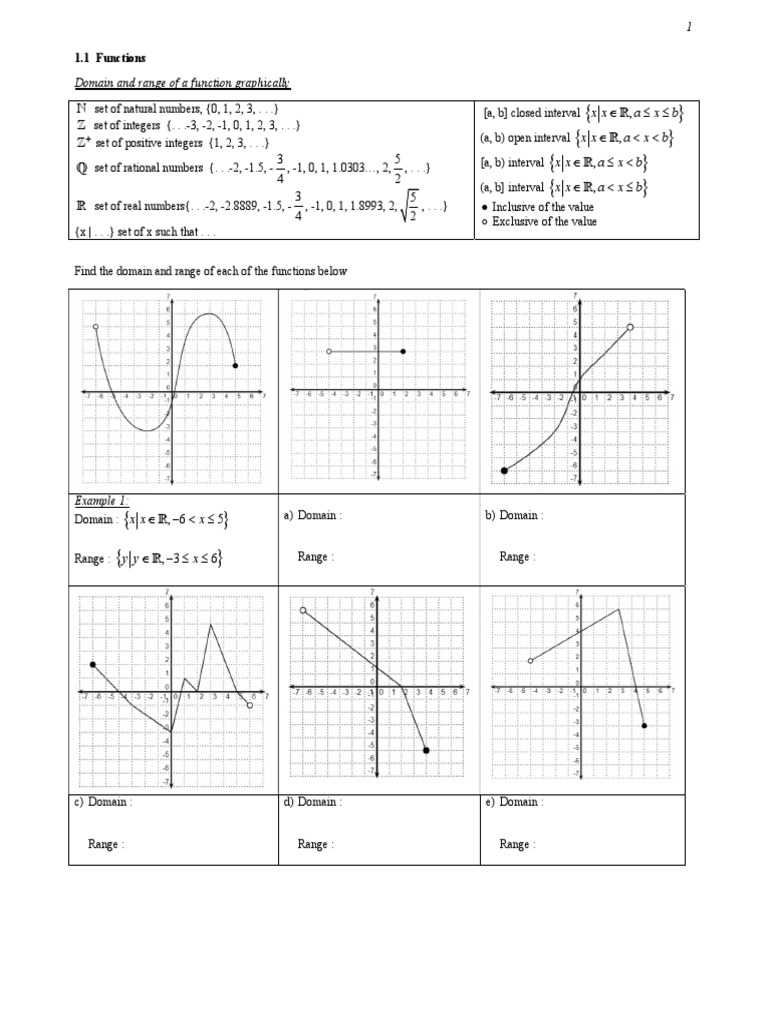
To effectively determine the intervals of input and output values on a plotted function, start by carefully analyzing the graph for the values that the function can take. Focus on identifying the set of possible input values along the x-axis and the corresponding output values along the y-axis. This method will guide you in determining both the feasible inputs and outputs.
One way to ensure accuracy is to pay attention to the continuous nature of the graph. If the function is continuous, the set of inputs and outputs will include all values within the observed intervals. For functions with breaks or discrete points, focus on identifying the distinct sets of values where the function is defined.
Make use of the proper notation to represent these intervals. For continuous functions, use interval notation such as [a, b] or (a, b), depending on whether the endpoints are included. For discrete functions, list the specific values or use set notation to indicate the distinct points. Always double-check that you’re capturing all possible input and output values as represented in the graph.
By breaking down each function visually, identifying the specific intervals, and applying the correct notation, you can avoid common mistakes and master the skill of analyzing functions efficiently.
Exercises Breakdown for Identifying Input and Output Intervals
When analyzing a plotted function, carefully assess the horizontal axis for input values and the vertical axis for corresponding output values. The task is to determine which values the function can take for both axes.
Start with continuous functions. Identify the intervals where the graph does not break. For example, if the graph shows a line segment between two points, the input values will cover all points within those endpoints. Represent these intervals using square brackets for closed intervals or parentheses for open intervals, depending on whether the endpoints are included.
For discrete functions, check for isolated points on the graph. These represent distinct values. List these values in set notation, such as {2, 4, 6}, to indicate the exact inputs where the function is defined. Avoid making assumptions about values that do not appear on the graph.
It is important to clearly distinguish between continuous and discrete data when solving exercises. Pay attention to whether the function includes all values between certain points or only specific, non-continuous ones.
| Type of Function | Input Interval Representation | Output Interval Representation |
|---|---|---|
| Continuous Function | [a, b] | (-∞, ∞) |
| Discrete Function | {2, 4, 6} | {-1, 0, 3} |
| Piecewise Function | [-2, 5), (6, 10] | [0, 4], {7, 8} |
By using proper notation and breaking down the graph step-by-step, identifying the values that define the function becomes a straightforward process. Always double-check to ensure no value is overlooked or misinterpreted.
Identifying Values from Plots
Start by examining the horizontal axis for input values. Identify the points where the curve starts, ends, and any breaks or jumps. For continuous functions, check the stretch of the graph along the x-axis to determine which values the function includes. If the graph extends infinitely in either direction, represent the inputs with a notation that indicates unbounded values, such as (-∞, ∞).
For isolated points or discrete functions, list only the specific input values shown on the plot. If the graph consists of distinct dots or separate sections, include each point separately, for instance, {1, 2, 3}.
Next, observe the vertical axis to determine the output values. Again, for continuous functions, identify the full set of y-values covered by the graph, whether it spans from negative infinity to positive infinity or has a restricted range. For discontinuous functions, note any gaps or separate output intervals.
Represent the output using similar notation as the inputs. Use parentheses for open intervals and square brackets for closed intervals. If the graph has distinct outputs, list them in set notation.
Always check the graph’s endpoints. If there is a filled dot at an endpoint, include that value in the interval. If the dot is open, exclude the value.
| Type of Function | Input Interval | Output Interval |
|---|---|---|
| Continuous | [-3, 5) | (-∞, 4] |
| Discrete | {1, 2, 3} | {-2, 0, 2} |
| Piecewise | [-4, 0) ∪ (2, 6] | {-5, 1, 3, 6} |
By carefully following these steps and paying attention to the endpoints and intervals, identifying the correct values from a plot becomes more accurate. Verify your findings by cross-checking input and output intervals with the visual representation of the graph.
Understanding the Concept of Input Values in Plots
Identify the input values represented along the horizontal axis. These values determine the set of inputs for which the function provides an output. Start by locating the leftmost and rightmost points of the plot. These points indicate the boundaries of the inputs. If the graph extends infinitely in one or both directions, represent the corresponding inputs with an unbounded interval notation, such as (-∞, ∞).
If the plot has discrete points, only the specific inputs shown on the graph are part of the set. For example, if the graph consists of isolated points, you would list the values as a set, such as {1, 2, 3}. For continuous functions, identify the continuous interval that includes all valid inputs.
Pay special attention to any gaps or holes in the plot. These might indicate that certain input values are excluded. For instance, if a hole appears at a particular x-value, that value is not part of the input set. Use open interval notation to exclude those values.
When the graph has endpoints, determine whether the inputs at the edges are included. If a filled dot is at the endpoint, that value is included in the set. If the dot is open, the value is excluded from the input set.
| Type of Representation | Input Set |
|---|---|
| Continuous Function | [-3, 5) |
| Discrete Points | {1, 2, 3} |
| Piecewise Function | [-4, 0) ∪ (2, 6] |
By systematically reviewing the input values and observing any gaps, endpoints, or intervals, you can determine the valid set of inputs represented by the plot. Always check for continuity and exclusions to accurately represent the input values.
How to Determine the Output Values from a Plot
To determine the set of output values from a plot, focus on the vertical axis. Identify the highest and lowest points that the curve or set of points reaches. These represent the minimum and maximum output values, respectively. If the plot has no end, use unbounded notation, such as (-∞, ∞), for outputs that extend infinitely.
For continuous functions, look for any gaps, jumps, or breaks in the plot along the vertical direction. These irregularities may indicate excluded values. For example, if the plot skips over certain vertical ranges, these values will not belong to the output set. Use interval notation to describe any continuous segments.
If the plot has discrete points, identify the exact output values that appear. These will be specific numbers and should be listed as a set. For instance, if the points are located at y-values of 1, 3, and 5, the output set is {1, 3, 5}.
For piecewise functions or graphs with multiple segments, check each section individually. Note the outputs for each segment and combine them to create the full output set. Be cautious of any points where the function changes direction, as these could mark boundaries or exclusions.
| Type of Representation | Output Set |
|---|---|
| Continuous Function | [-2, 4] |
| Discrete Points | {0, 1, 4} |
| Piecewise Function | [-3, 1) ∪ (2, 5] |
Always check for any excluded outputs, such as holes or open endpoints. These can help refine the output set and ensure that only valid values are included. With this approach, you can confidently determine the output values from any given plot.
Common Mistakes in Domain and Range Calculations
One common mistake is misinterpreting the set of valid input values. It’s crucial to carefully observe whether the function is defined at every point in the possible input range. If the function is undefined for certain values, these must be excluded from the set.
Another frequent error is failing to recognize open or closed intervals. Pay attention to whether a value is included in the set (closed) or excluded (open). A mistake often occurs when dealing with boundary points, especially in piecewise functions where different conditions apply to different segments.
- Example of a mistake: Incorrectly including a boundary point that is not part of the function’s output.
- How to avoid: Verify whether the boundary points are part of the output by checking whether the function value at that point is defined or not.
Also, avoid confusion when dealing with vertical asymptotes. These often mark excluded input values but can easily be overlooked as valid points. Always check for discontinuities or gaps in the graph to identify potential exclusions.
- Example: Including values that the function approaches but never actually reaches, such as values at vertical asymptotes.
- How to avoid: Recognize asymptotes as boundaries that cannot be included in the valid input set.
Another mistake involves misinterpreting a function’s behavior at infinity. Infinite outputs or inputs are often represented as unbounded, and many mistakenly treat these as finite ranges. Always use the appropriate notation for infinity.
- Example: Mistaking a function that approaches infinity for a function that has a maximum value.
- How to avoid: When a function has no maximum or minimum value, use infinity notation (∞) to represent the unbounded nature of the values.
Finally, errors can arise when calculating output values for discrete functions. Discrete points should only be included in the output set if they are explicitly given in the function’s definition. Avoid assuming continuous output when the function is defined at specific points.
- Example: Including values that are not explicitly marked on the plot or table as part of the output.
- How to avoid: Only include output values that are explicitly shown in the function’s graph or defined in the problem statement.
Visualizing Domain and Range with Examples
To effectively understand the set of possible inputs and outputs, observe the visual representation. For instance, in a simple continuous curve, the valid inputs form a horizontal span on the x-axis, while the valid outputs form a vertical span on the y-axis.
Consider a function defined by a parabola. The input values cover all real numbers on the x-axis, but the output values are restricted to values greater than or equal to the vertex’s y-coordinate. This helps clarify that while inputs are unlimited, the possible outputs are bounded.
- Example 1: For a parabola with the vertex at (0, 0), the set of inputs includes all real numbers, while the set of outputs is y ≥ 0.
- How to visualize: Mark the x-axis as continuous, and shade the region above the vertex on the y-axis to represent the valid output values.
Next, consider a piecewise function with different behaviors in different regions. This function may have discontinuities or restricted intervals where it is undefined. These points of discontinuity should be excluded from the valid input set. For example, a function with a vertical asymptote at x = 2 will have all inputs except for x = 2.
- Example 2: A function with a vertical asymptote at x = 2 has valid input values for x ≠ 2, and the outputs can range from negative to positive infinity.
- How to visualize: Draw a vertical dashed line at x = 2 to show the excluded input and draw arrows along the y-axis to show the infinite nature of the output.
When dealing with discrete points, such as in a step function, the inputs are limited to specific values, and the outputs are also limited to certain discrete values. This type of function may look like a set of isolated dots on the graph.
- Example 3: For a step function that is defined only at x = -1, 0, and 1, the output values might be y = 2, y = 3, and y = 4, respectively.
- How to visualize: Plot each point as a dot on the graph, with no continuous line connecting them, to show the discrete nature of both the input and output.
Understanding these visual cues and the specific shape of each function will help solidify the concept of valid inputs and outputs. By observing key points like vertices, asymptotes, and boundaries, you can accurately determine the set of inputs and outputs for any function.
Handling Different Types of Graphs: Discrete vs Continuous
When working with functions, understanding the difference between discrete and continuous representations is crucial for identifying valid inputs and outputs.
For discrete functions, the set of inputs is limited to specific values. These functions are often represented by isolated points on a coordinate plane, meaning that there are no values between the given points. To determine the valid inputs, focus on the specific x-values where the function is defined.
- Example 1: A function defined only at x = -1, 0, and 1. In this case, the valid inputs are just those three points.
- How to handle: Plot individual points on the graph without connecting them to show that only specific inputs are valid.
For continuous functions, the set of valid inputs typically forms an interval, meaning any value within the interval is valid. These functions are represented by a smooth curve or line. To determine the valid inputs, identify the interval on the x-axis where the function exists and is continuous.
- Example 2: A function that is defined for all real numbers, such as a quadratic equation. Here, the input can be any real number.
- How to handle: Draw a smooth curve without breaks to indicate that all x-values within the defined interval are valid inputs.
Be mindful of discontinuities in continuous functions. Points where the function jumps or has holes require careful attention. In such cases, the valid input set excludes the points where the function is not defined.
- Example 3: A function with a hole at x = 2. The valid inputs are all real numbers except for x = 2.
- How to handle: Plot a hole or a dashed line at x = 2 to represent the exclusion of that value.
In summary, recognizing whether a function is discrete or continuous will guide how you interpret its set of valid inputs. Use isolated points for discrete functions and smooth curves for continuous functions, while being attentive to any discontinuities in continuous functions.
Graphing Techniques for Domain and Range Exercises
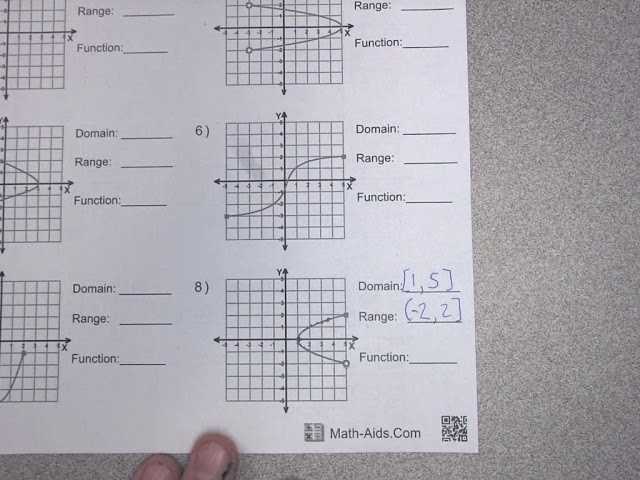
Start by identifying the key characteristics of the function. For discrete functions, plot individual points corresponding to the allowed inputs. These points should not be connected by lines, as they represent specific values where the function is defined. For example, if the function is only valid at x = 1, 2, and 3, plot those points and leave gaps between them.
For continuous functions, draw a smooth curve or line that represents all the values between the specified inputs. This means that any value within the interval on the x-axis is valid. Make sure the curve is unbroken unless there are discontinuities, in which case, mark the breaks with holes or dashed lines to indicate missing values.
If the function has a restricted set of valid inputs, such as when there is a hole or vertical asymptote, mark these points carefully. For example, if the function is undefined at x = 2, plot a hole at that point and exclude it from the curve. If there’s an asymptote, indicate it with a dashed line that the curve approaches but never touches.
Using graphing software or a graphing calculator can help ensure precision when plotting complex functions. Tools like Desmos (https://www.desmos.com) allow for quick visualizations of functions and are highly recommended for checking your work.
How to Double-Check Your Results for Accuracy
To ensure accuracy, start by reviewing the function’s definition and its specified limitations. Confirm that you are considering all valid inputs and that no values are overlooked. Pay attention to points where the function might be undefined or discontinuous, such as vertical asymptotes or holes in the curve.
Next, check the plotted points against the function’s equation or table of values. Each plotted point should correspond precisely to the correct value of the function at a given input. If the function is continuous, verify that the line or curve smoothly connects the points without any gaps unless specified.
Use graphing software or a calculator to plot the function and compare it with your manual graph. Tools like Desmos or GeoGebra can help you verify that your graph matches the expected output, especially for complex functions.
Finally, recheck the boundaries for the valid inputs and outputs. For example, make sure that the correct limits are marked on both the x and y axes, indicating where the function is defined and where it is not.