How to Read and Interpret Solubility Curves in Chemistry
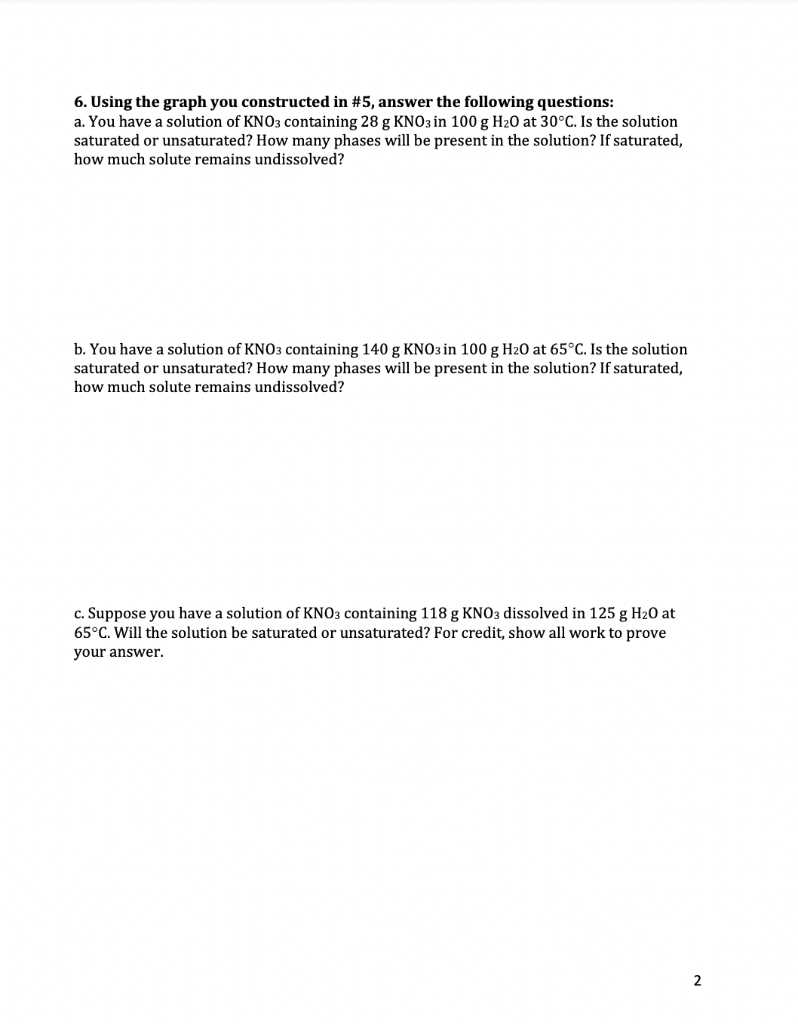
Examine the graph carefully to identify the relationship between temperature and the amount of solute that can dissolve in a given solvent. Pay attention to how solubility increases or decreases with temperature changes. These trends are crucial for understanding the behavior of different substances under varying conditions.
For precise calculations, mark the saturation point where no more solute can dissolve in the solution. This point is vital for determining whether a solution is unsaturated, saturated, or supersaturated. Ensure that you check the solute’s behavior at different temperatures to predict potential crystallization or precipitation.
Use the graph to predict outcomes for experiments. If you need to find the exact solubility at a particular temperature, locate the corresponding value on the curve. This will help you determine whether more solute can be dissolved or if the solution has reached its maximum capacity.
Lastly, keep in mind that mistakes can occur if the graph is not interpreted properly. Always verify that the axes are read correctly and that the temperature and solubility values match the conditions of your experiment. Practicing with various substances and temperature ranges will improve your skills in interpreting these graphs accurately.
How to Analyze Solubility Data Step by Step
Step 1: Understand the Axes
The graph you are working with will have two axes. The horizontal axis (x-axis) typically represents temperature, while the vertical axis (y-axis) indicates the amount of solute that can be dissolved in the solvent at each temperature. Be sure to understand the units on both axes before proceeding.
Step 2: Identify the Solubility Curve
Look for the curve that represents the substance in question. Each substance has its own curve, which shows how its solubility changes with temperature. Different substances have different curves, so be sure you are focusing on the correct one.
Step 3: Find the Solubility at a Given Temperature
To determine the solubility of a substance at a specific temperature, locate the corresponding temperature on the x-axis, then find the point where the solubility curve intersects the vertical line at that temperature. Follow the curve to the y-axis to read the solubility value.
Step 4: Recognize the Trend
Most solid solutes become more soluble as the temperature increases. However, some solutes may show a decrease in solubility with temperature. By analyzing the slope of the curve, you can identify whether the substance behaves according to typical patterns or if it exhibits unusual behavior.
Step 5: Interpret the Solution’s Saturation
Once you know the solubility at a given temperature, you can determine the saturation level of a solution. If the amount of solute in the solution is equal to or less than the solubility at that temperature, the solution is saturated or unsaturated, respectively. If the amount of solute exceeds the curve’s value, the solution is supersaturated.
Step 6: Predict Solubility at Different Temperatures
The curve can also be used to predict solubility at temperatures not directly listed. For example, if you need to know the solubility at 35°C, find the point on the x-axis corresponding to 35°C, and trace up to the curve to determine the solubility at that temperature.
For further detailed information, consult trusted resources like LibreTexts Chemistry.
Understanding the Basics of Solubility Graphs
1. Structure of the Graph
A typical graph that displays the relationship between the amount of solute and temperature has two axes. The horizontal axis (x-axis) represents temperature, usually in degrees Celsius. The vertical axis (y-axis) shows the maximum quantity of solute that can dissolve in a solvent at each given temperature. The data is often plotted as a curve or a series of points connected by lines.
2. The Shape of the Curve
The shape of the plotted line indicates how the solubility of a substance changes with temperature. For most solid solutes, the solubility increases as the temperature rises. The line typically slopes upward to the right, showing that more solute can dissolve at higher temperatures. However, some substances may behave differently, such as gases, where solubility decreases with an increase in temperature.
3. Understanding Saturation
The curve helps determine the saturation level of a solution. At any given temperature, if the amount of solute is less than or equal to the solubility value on the graph, the solution is unsaturated. If it matches the curve, the solution is saturated, and if the solute exceeds the value, the solution is supersaturated. This concept is important in understanding how solutions behave under different conditions.
4. Solubility at Specific Temperatures
By locating a specific temperature on the x-axis, you can trace vertically to the curve and then horizontally to the y-axis to read the solubility at that temperature. This allows for precise calculations of how much solute can be dissolved in a solvent under varying conditions.
5. Predicting Behavior
Once you understand the relationship between temperature and solubility, you can predict how the solubility of a substance will change at temperatures not directly shown on the graph. Simply locate the temperature of interest on the x-axis and extrapolate the value based on the curve’s slope.
How to Identify Key Information on a Solubility Graph
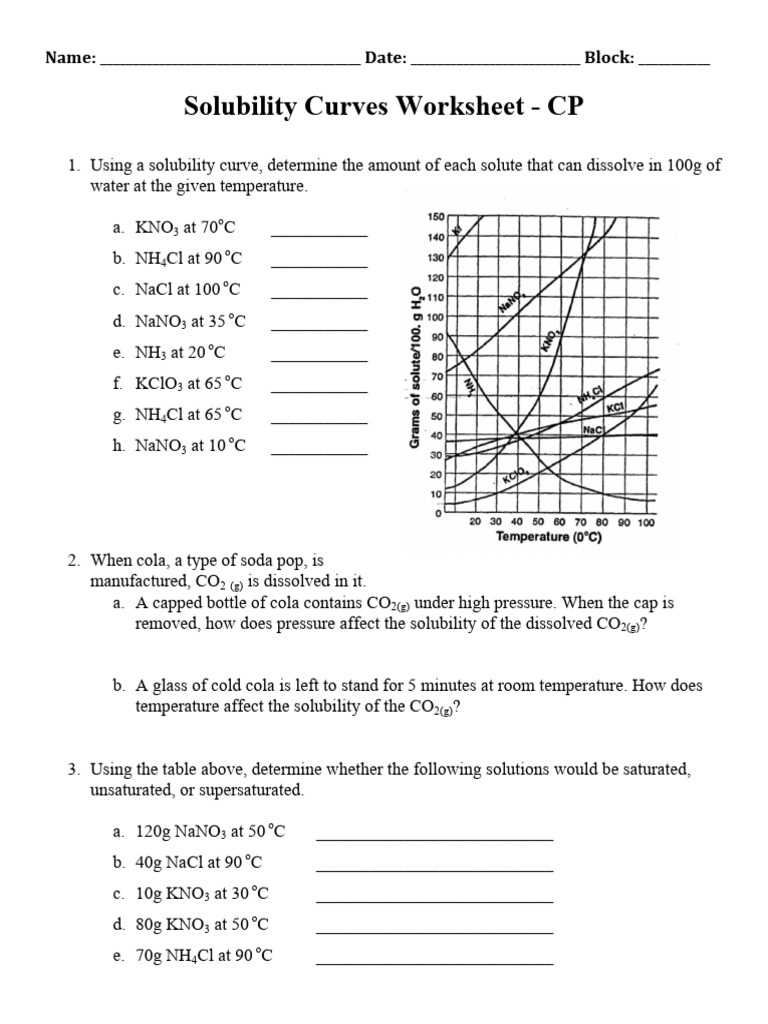
1. Locating the Saturation Point
Find the point where the solubility curve intersects the vertical axis. This point shows the maximum amount of solute that can dissolve in the solvent at the given temperature. Any point below this line indicates an unsaturated solution, while any point above it represents a supersaturated solution.
2. Identifying Temperature and Solute Quantity
To find the solubility at a specific temperature, locate the temperature on the horizontal axis. Trace vertically to the curve, then horizontally to the vertical axis to read the solute quantity. This allows for quick identification of the solute’s solubility under varying conditions.
3. Interpreting the Slope
The slope of the graph indicates how the solubility changes with temperature. A steep slope means the solubility increases rapidly as the temperature rises, while a gradual slope indicates a slower increase in solubility. A flat line suggests that solubility remains constant across temperature changes.
4. Recognizing Special Cases
For some solutes, the solubility may decrease as the temperature rises. This is common for gases dissolved in liquids. Look for curves that slope downward, indicating that the solute becomes less soluble at higher temperatures.
5. Determining the Effect of Saturation
The curve provides information about saturation levels. When the amount of solute equals the solubility value for a given temperature, the solution is saturated. This is critical for understanding whether a solution can dissolve additional solute or not.
Interpreting Temperature and Solubility Relationships
1. Temperature Increase and Solubility of Solids
As the temperature rises, most solid solutes dissolve more readily in a liquid. This is reflected by an upward slope on the graph. For example, if you examine the curve for salt or sugar in water, you’ll notice that as the temperature increases, more of the solute can dissolve. The steeper the curve, the more significant the temperature effect on solubility.
2. Temperature Decrease and Solubility of Gases
In contrast to solids, gases become less soluble as the temperature increases. This is due to the increased kinetic energy, which causes gas molecules to escape from the solution. A downward slope on the graph indicates this inverse relationship. For gases like carbon dioxide, the solubility decreases as the temperature rises, which is why soda fizzes more at higher temperatures.
3. Linear vs. Nonlinear Temperature-Solubility Trends
Not all solutes follow a simple linear relationship with temperature. Some may show a rapid increase in solubility at lower temperatures, which slows down at higher temperatures. This non-linear trend is common with certain compounds and should be carefully noted when analyzing the graph.
4. Identifying Saturation Points
The saturation point on a solubility-temperature graph shows the maximum concentration of solute that can dissolve at a given temperature. At this point, any additional solute will not dissolve and will instead form a precipitate. Recognizing the saturation point helps determine the solubility limit of a solute in a specific solvent at a certain temperature.
5. Comparing Solubility of Different Substances
Temperature affects different substances in unique ways. Some solutes, like potassium nitrate, exhibit a sharp increase in solubility with temperature, while others, like calcium sulfate, show little change. Comparing these trends on the graph helps understand how temperature can influence different solutes and their dissolving behavior.
Determining Saturation Points from the Curve
1. Locate the Flat Section of the Graph
The saturation point corresponds to where the curve levels off. This flat region indicates the maximum amount of solute that can dissolve in the solvent at a specific temperature. Once the graph flattens, any additional solute added will no longer dissolve and will precipitate out.
2. Identify the Temperature on the X-Axis
To determine the saturation point at a given temperature, locate the temperature value on the x-axis. Follow this value vertically until it intersects the solubility curve. The solubility at this point corresponds to the amount of solute that can dissolve in the solvent at that temperature.
3. Check for Supersaturation
If the solution contains more solute than the saturation point indicates, it is in a supersaturated state. This can be observed if the solute concentration appears higher than what the curve suggests is possible at that temperature. Supersaturated solutions are unstable and can lead to the sudden crystallization of the excess solute.
4. Use the Curve to Predict Saturation for Multiple Temperatures
To determine the saturation point at different temperatures, simply repeat the process for each temperature along the x-axis. As temperature increases, the solubility limit generally rises, meaning the solute will dissolve more as the temperature increases.
5. Mark the Saturation Concentration
For precise results, it’s helpful to mark the solubility value where the curve flattens. This value, usually expressed in grams of solute per 100 mL of solvent, gives a clear indication of how much solute can remain dissolved at that temperature before reaching saturation.
How to Find Solubility of Different Substances at Specific Temperatures
1. Identify the Substance on the Graph
Each substance has a unique curve on the graph. Locate the substance’s curve, which is often labeled or represented with different lines for each solute. This curve indicates how its solubility changes with temperature.
2. Find the Desired Temperature on the X-Axis
Locate the temperature on the x-axis (usually measured in degrees Celsius). Draw a vertical line from the temperature mark upwards to where it intersects the substance’s curve. The point of intersection represents the maximum amount of solute that can dissolve at that temperature.
3. Read the Solubility Value on the Y-Axis
From the point where the vertical line intersects the curve, trace horizontally to the y-axis. This will give the solubility value, which is typically shown as grams of solute per 100 mL of solvent. This value represents the concentration of solute that can be dissolved at the given temperature.
4. Repeat for Different Temperatures
To find solubility at various temperatures, repeat the process for each temperature of interest. For example, if you need to know how a substance behaves at multiple temperatures, use the graph to determine the solubility at each one by following the same steps.
5. Compare Solubility of Different Substances
By comparing the solubility values at the same temperature for different substances, you can identify which substances dissolve more readily at that specific temperature. This is useful for understanding their relative solubility behavior.
Using the Curve to Predict Crystallization and Precipitation
1. Identify the Saturation Point
Find the solubility limit for a substance at a given temperature. The point where the curve flattens indicates the maximum concentration of solute that can remain dissolved. Any concentration beyond this point is likely to result in crystallization or precipitation.
2. Determine the Effect of Temperature
When the solution cools, its solubility decreases. Track the change in solubility by following the curve’s downward slope as temperature drops. If the solution is supersaturated (above the solubility limit for the lower temperature), crystallization is likely to occur as the solute begins to precipitate.
3. Monitor Solution Conditions
If the concentration exceeds the solubility limit at any temperature, the excess solute will start to precipitate out of the solution. The curve helps to predict this by showing the temperature at which precipitation will occur for a given concentration.
4. Use the Curve to Control Precipitation
By adjusting temperature, you can control when and how much solute precipitates. For instance, lowering the temperature of a supersaturated solution will encourage crystallization at the point where the curve intersects the lower solubility values.
5. Monitor for Crystallization
When the system cools and the solute starts to crystallize, observe the behavior of the substance at different temperatures. This can be predicted using the curve, which shows the temperature and concentration ranges at which crystallization begins.
Common Mistakes When Reading Solubility Curves and How to Avoid Them
1. Confusing Saturation with Supersaturation
Ensure that the point where the solute no longer dissolves is correctly identified. If a solution is above this point on the graph, it is supersaturated, and precipitation is imminent. Double-check the curve to avoid confusing the solubility limit with saturation.
2. Misreading Temperature Scales
Accurate temperature readings are crucial. Always confirm that the temperature axis is correct and corresponds to the values on the graph. Errors can occur if the temperature is misinterpreted or if the graph uses a non-linear scale.
3. Overlooking the Units
Pay attention to the units of concentration and temperature on the graph. Common mistakes include confusing grams per liter with moles per liter or failing to adjust the values based on temperature changes. Always ensure the units are consistent with the problem at hand.
4. Ignoring the Curve’s Slope
The slope of the curve indicates how solubility changes with temperature. A common mistake is failing to interpret this correctly, assuming solubility remains constant when it is actually increasing or decreasing. Check the curve’s direction carefully at different points.
5. Not Considering Impurities
Impurities can affect the solubility of a substance. If the graph represents a pure solute, remember that the presence of other substances could shift the solubility limit. Take this into account when making predictions from the graph.
6. Misidentifying Precipitation Points
If the graph shows a supersaturated solution, precipitation will occur once it surpasses the solubility threshold. Do not mistake this as a point where the solute simply remains dissolved. Precipitation occurs once the limit is exceeded, so check for that transition carefully.
7. Assuming Linear Behavior
The relationship between solubility and temperature may not always be linear. Be cautious of assuming the curve will always increase or decrease in a straight line. Some substances exhibit non-linear behavior, especially at higher temperatures.
Practical Applications of Solubility Curves in Chemistry
1. Predicting Precipitation
By examining the graph, it is possible to predict when a substance will precipitate from a solution. If the concentration of solute exceeds the limit indicated at a given temperature, precipitation occurs. This helps in designing processes to control crystallization.
2. Designing Chemical Reactions
Understanding how temperature affects the dissolution of substances allows chemists to optimize reaction conditions. In reactions where solubility plays a role, adjusting temperature ensures the right amount of solute is dissolved, improving reaction efficiency.
3. Industrial Applications in Purification
In industries like pharmaceuticals and food processing, solubility data guides purification processes. By adjusting temperature, unwanted impurities can be separated, or desired solute concentrations can be reached more effectively during crystallization or filtration.
4. Formulation of Solutions
Solubility graphs help chemists determine the maximum concentration of solute that can be dissolved in a solvent at a specific temperature. This is particularly important in formulating solutions with consistent concentration, such as in drug development or laboratory reagent preparation.
5. Environmental Science and Waste Treatment
In environmental chemistry, solubility curves assist in predicting how pollutants behave in different conditions. For instance, understanding the solubility of metals or organic compounds in water helps design effective treatment methods for removing contaminants from water sources.
6. Teaching and Laboratory Experiments
Solubility data is widely used in educational settings to demonstrate the relationship between temperature and solubility. Experiments involving the heating or cooling of solutions to observe changes in dissolution rates provide hands-on experience for students in chemistry labs.
7. Enhancing Material Properties
In material science, solubility curves can guide the creation of alloys or composite materials. By understanding how solutes dissolve at various temperatures, manufacturers can design materials with specific properties, such as improved strength or flexibility.