Complete Guide to Solving Two Step Equations with Color by Number
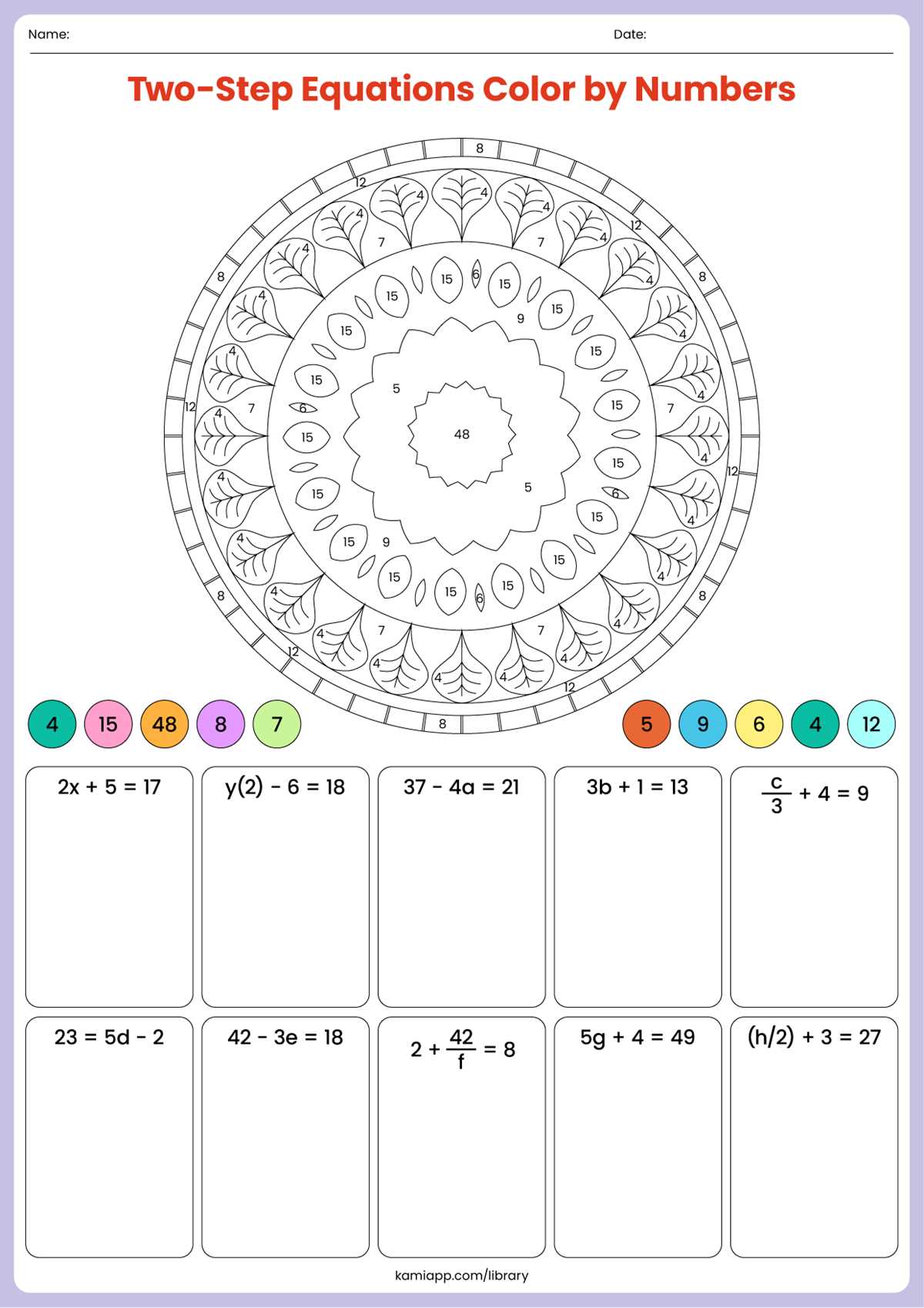
Start by isolating the variable in each equation. This step is key to simplifying the process, allowing you to focus on the numerical values. Remember, your goal is to gradually reduce the problem into smaller, manageable parts. Begin with eliminating constants through basic arithmetic, ensuring that each operation is performed step by step.
Once you’ve simplified each equation, proceed to solving for the unknown by applying the inverse of operations. Use the same approach for all the problems in the set, ensuring that you maintain consistent methods across similar equations. These skills will not only help in completing the puzzles but will also reinforce your understanding of algebraic principles.
As you solve each equation, match the solution with the corresponding color. The color pattern will serve as an indicator of how well you’ve tackled the problem. Be mindful of the numbers you assign to specific colors, as they directly correlate with your results. Check your work to avoid common errors, such as skipping steps or miscalculating, which can result in incorrect answers and a mismatched solution.
Step-by-Step Process for Solving Two-Step Problems
Begin by isolating the variable term. This is achieved by first eliminating the constant from one side of the equation. Use addition or subtraction, depending on the sign of the constant. For example, if you have the equation 3x + 5 = 11, subtract 5 from both sides to get 3x = 6.
Next, solve for the variable by applying the inverse operation to the coefficient. In this case, divide both sides by 3 to get x = 2. This operation removes the coefficient attached to the variable, leaving you with the solution.
Double-check your result by substituting the value of the variable back into the original equation to verify if both sides are equal. If the equation holds true, your solution is correct.
Repeat these steps for each problem in your set, ensuring that you follow the same methodical approach. This will help you achieve accurate results in every instance.
How to Use the Color by Number Method in Math Puzzles
Start by solving the math problem as you normally would, following the basic operations to isolate the variable and solve for its value. Once you’ve found the solution, refer to the chart or key that links the values of the variable to specific colors or symbols. For instance, if the result of your calculation is 4, and the chart indicates that the number 4 corresponds to red, you will shade the corresponding area with red.
Make sure to double-check the value of the variable before coloring. Accuracy in the solution is crucial, as each color represents a specific mathematical result. Miscalculating can lead to incorrect coloring, disrupting the puzzle’s final picture or pattern.
For puzzles with multiple steps, break down the process step by step. After solving each part, use the associated color for the number you find. This method not only makes solving problems more engaging but also helps reinforce the connection between numerical solutions and their real-world representations.
By following this process, you can enjoy both the satisfaction of solving the math problem and the visual reward of completing the puzzle. The color coding adds an extra layer of fun to your learning experience, encouraging both precision and creativity.
Tips for Quickly Identifying Two-Step Equations
Look for equations where the variable appears on one side of the equation, and there are two distinct operations being performed on it. Typically, one operation is multiplication or division, and the other is addition or subtraction. These are the classic indicators of a two-step structure.
Check for parentheses, fractions, or exponents. If these are present, they may add complexity, but they don’t change the core two-step structure. Simplify any complicated terms first, and identify the two operations that need to be undone.
Rearrange the equation by isolating the term with the variable. If there’s addition or subtraction, start by eliminating it with the inverse operation. After that, address the multiplication or division part, using the inverse operation again.
For example, in an equation like 3x + 5 = 20, subtract 5 from both sides, and then divide both sides by 3. This approach helps streamline the process and makes it easier to spot the necessary steps for solving.
Practice recognizing these patterns quickly by solving multiple examples. The more familiar you become with the structure, the faster you will identify these types of problems. Keep an eye out for the two separate operations, and solve in the correct order to avoid confusion.
Understanding the Role of Operations in Two-Step Equations
In equations involving multiple operations, each operation plays a specific role in altering the variable’s value. Identifying and understanding these roles is critical for solving the equation correctly. Typically, two operations are involved: one that changes the variable through multiplication or division, and another through addition or subtraction.
The first operation is usually the one that affects the value of the variable most directly. If the variable is being multiplied or divided, start by undoing that operation first, using the inverse operation. For instance, if the variable is being multiplied by a coefficient, divide both sides of the equation by that number to isolate the variable.
The second operation typically involves addition or subtraction. Once the variable has been isolated through multiplication or division, the remaining operation can be reversed. For example, if the equation involves adding a number to the variable, subtract that number from both sides to balance the equation.
When working with these types of problems, remember that each operation must be performed in reverse order of how they appear in the equation. This process ensures that the value of the variable is adjusted correctly, allowing you to solve for the unknown efficiently and accurately.
Common Mistakes to Avoid When Solving Two-Step Equations
Avoid skipping the inverse operations: One of the most common errors is neglecting to apply the inverse operation correctly. If the equation involves multiplication, always divide both sides to isolate the variable. Similarly, if the operation is addition, subtract from both sides.
Misinterpreting the order of operations: Many learners forget to handle the multiplication or division first before addition or subtraction. Remember to reverse the operations in the correct order to maintain balance in the equation.
Failing to apply operations to both sides: Never forget to apply changes to both sides of the equation. Whether it’s adding, subtracting, multiplying, or dividing, always perform the same operation to both sides to ensure the equality is preserved.
Incorrectly handling negative signs: Pay special attention to negative numbers. When multiplying or dividing by negative values, ensure the sign changes are correct. Errors in sign handling can lead to incorrect solutions.
Not simplifying the equation fully: After applying the inverse operation, simplify the equation completely before checking the solution. Some students stop before reducing the equation fully, leading to inaccurate results.
How to Check Your Solutions for Accuracy in Puzzles
First, substitute your solution back into the original expression. Verify that both sides of the equation are equal after substitution. If the equation holds true, your solution is correct.
Use reverse operations to double-check the calculations. For instance, if you initially added to isolate the variable, subtract in your verification step to ensure the original equation is restored.
Inspect your work for any skipped operations or mistakes in arithmetic. Review each operation carefully to avoid simple errors such as sign mistakes or misapplied operations.
Verify the consistency of your results. Solve the puzzle step-by-step again and check if the same solution emerges. Repetition can help identify inconsistencies and confirm accuracy.
Lastly, cross-reference your solution with a reference or solution guide, if available. Comparing your results against a trusted source ensures that your method and conclusion are correct.
Advanced Techniques for Solving Complex Two-Step Equations with Color by Number
To handle more complicated problems, start by breaking the equation into smaller parts. Identify the first operation that will isolate the variable, then proceed with the inverse operation to simplify further.
When dealing with variables on both sides of the equation, first collect like terms. This step may require you to subtract or add terms from both sides to move the variables together, making it easier to solve.
For expressions involving fractions, multiply both sides by the least common denominator (LCD) to eliminate the fractions. This step will result in a more manageable equation, simplifying the process of solving.
If the equation contains parentheses, apply the distributive property to remove them before proceeding with other operations. This will ensure that the equation is in its simplest form for the next steps.
Another useful strategy is to use trial and error when solutions are not immediately obvious. This involves testing different values for the variable to see if they satisfy the equation. Once a possible solution is found, substitute it back into the original equation to check for accuracy.
For more complex problems, consider using a systematic approach to check each calculation at every stage. Keep track of every operation performed and verify each result to avoid mistakes.
To enhance accuracy, cross-check solutions with available online calculators or step-by-step guides. Websites like Khan Academy offer a detailed walkthrough of various algebraic techniques and problem-solving methods.