Key Concepts and Answers for Natural and Artificial Selection
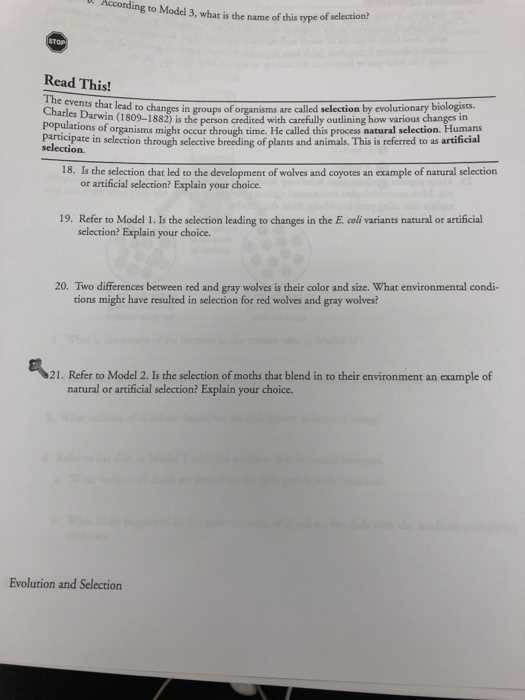
Identify the specific traits that favor survival or reproduction in certain organisms: Organisms with advantageous characteristics are more likely to pass on their genes, enhancing their frequency in future generations. These traits can range from physical features to behavioral adaptations that increase survival rates in a given environment.
Understand how human influence alters genetic outcomes: Through controlled breeding, humans can direct the propagation of specific traits, leading to predictable changes in populations over time. This method is commonly used in agriculture and animal breeding, where certain characteristics are desired in crops or livestock.
Recognize the role of environmental pressures: Selection pressure, like climate, food availability, or predators, influences the direction of change. Organisms that better adapt to these pressures are more likely to thrive, while others may become extinct or evolve into new forms.
Consider the differences in process outcomes: While one process depends on random mutations and survival of the fittest, the other involves deliberate human choice to achieve desired outcomes. Both result in the alteration of genetic traits within a population, but the mechanisms and timescales can differ significantly.