Complete Solutions for the Ideal Gas Law Worksheet
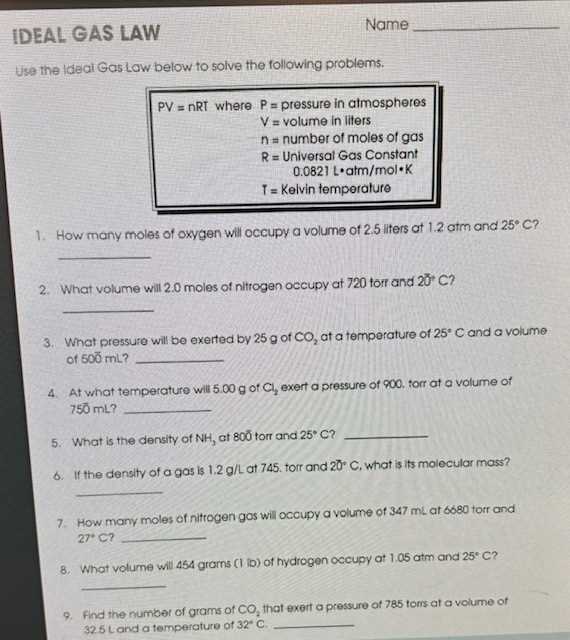
When solving problems related to the behavior of gases, it’s crucial to focus on the correct application of variables like pressure, volume, and temperature. Understanding how these factors interact allows for precise calculations and helps avoid common errors. Always check that your units are consistent and the equation is applied correctly to avoid mistakes in your results.
Before tackling specific problems, familiarize yourself with the formula that relates these variables: PV = nRT, where P is pressure, V is volume, n is the number of moles, R is the universal gas constant, and T is temperature. Having a solid grasp of the components of this equation will guide you through the steps of any related exercise.
As you work through the exercises, make sure to first identify the known values in each problem, and then solve for the unknowns. Pay attention to the units involved, and make sure they align with the constant R (8.314 J/(mol·K)) for proper consistency in your calculations.
This guide will help clarify common pitfalls and offer detailed steps for solving typical questions, improving your accuracy and confidence with gas-related math problems.
Complete Guide to Solving the Ideal Gas Problems
To solve problems based on the relationship between volume, pressure, and temperature, begin by identifying the known and unknown values in the given exercise. Make sure you are using consistent units, especially for temperature (Kelvin) and pressure (Pascals or atm), and convert where necessary.
Start with the formula: PV = nRT. Isolate the variable you need to find. For instance, if you need to calculate the pressure, the formula becomes P = nRT / V. If you need to solve for volume, rearrange to V = nRT / P. Be sure to double-check the units of each variable to ensure they align with the gas constant, R.
Here’s a step-by-step method for tackling these problems:
- Identify the given values: Recognize the values for volume (V), pressure (P), number of moles (n), and temperature (T). These will often be directly provided in the problem.
- Convert units: Make sure temperature is in Kelvin (K), and pressure and volume are in compatible units with the gas constant R.
- Apply the formula: Plug the known values into the formula. Solve for the unknown value by isolating the variable you’re solving for.
- Check for consistency: Ensure that all units are correct, and the equation is applied correctly. If the result seems unreasonable, check for calculation errors or unit mismatches.
- Recheck the result: Once you’ve solved the equation, compare your results with expectations. For example, if you are calculating volume, ensure the result makes sense in the context of the problem.
Here’s an example problem and solution:
| Given | Value |
|---|---|
| Pressure (P) | 1.5 atm |
| Volume (V) | 3.0 L |
| Temperature (T) | 298 K |
| Number of moles (n) | 0.25 mol |
Step 1: Use the formula P = nRT / V
Step 2: Plug in the values: P = (0.25 mol) * (0.0821 L·atm / mol·K) * (298 K) / (3.0 L)
Step 3: Simplify to get P = 0.204 atm
This solution shows how to approach the calculation for pressure using the ideal gas equation. Always remember to check your units and results after performing the calculations.
Understanding the Ideal Gas Equation
The equation PV = nRT is a fundamental relation in chemistry that connects the pressure, volume, temperature, and amount of gas. This formula allows for the calculation of one variable when the others are known.
Each variable in this equation represents:
- P: Pressure of the gas, typically measured in atmospheres (atm) or pascals (Pa).
- V: Volume of the gas, usually measured in liters (L) or cubic meters (m³).
- n: Number of moles of the substance, representing the amount of gas.
- R: Ideal gas constant, which varies based on the units used. The most common value is 0.0821 L·atm / (mol·K).
- T: Temperature of the gas, always in Kelvin (K) for consistency.
To use this equation effectively, it’s crucial to ensure that all units are consistent. For instance, if pressure is given in atm, volume in liters, and temperature in Kelvin, use the gas constant value of 0.0821 L·atm / (mol·K). If using pascals for pressure or cubic meters for volume, ensure the appropriate value for R is used, such as 8.314 J / (mol·K).
For solving, isolate the desired variable depending on the problem. For example, to find volume, rearrange the formula to V = nRT / P. If solving for temperature, use T = PV / nR.
By carefully selecting the correct units and applying the formula properly, you can accurately solve problems involving the behavior of gases under various conditions.
Step-by-Step Method for Solving Gas Problems
To solve problems involving the relationship between pressure, volume, temperature, and quantity of a substance, follow these clear steps:
- Identify known variables: Start by carefully reading the problem and identifying the values provided for pressure, volume, temperature, or amount of substance. Write them down, including units.
- Choose the correct equation: Use the fundamental equation PV = nRT where P is pressure, V is volume, n is the number of moles, R is the gas constant, and T is temperature. If the problem involves changes in conditions, you may need to use the combined gas equation: P1V1/T1 = P2V2/T2.
- Rearrange the equation: Isolate the variable you need to solve for. For example, if you need to calculate volume, rearrange the equation to V = nRT / P.
- Check units: Ensure that the units for pressure, volume, and temperature are consistent with the constant R you are using. If pressure is in atmospheres, volume in liters, and temperature in Kelvin, use R = 0.0821 L·atm / (mol·K). If using pascals or cubic meters, use R = 8.314 J / (mol·K).
- Substitute known values: Plug the known values into the equation, ensuring proper unit conversion if necessary. Perform the arithmetic to solve for the unknown.
- Verify your result: Double-check your solution to ensure it makes sense physically. If the answer seems unrealistic (e.g., negative volume or pressure), review your calculations or assumptions.
By following these steps, you can accurately solve any problem that involves the behavior of gases under different conditions.
Common Mistakes to Avoid in Gas Calculations
To avoid errors when solving for the behavior of gases, be mindful of these common pitfalls:
- Incorrect Unit Conversion: Always ensure that units are consistent. For example, pressure must be in atmospheres or pascals, volume in liters or cubic meters, and temperature in Kelvin. Forgetting to convert units can lead to incorrect results.
- Using Incorrect Value for the Gas Constant: The gas constant R varies depending on the units used. If pressure is in atmospheres and volume in liters, use R = 0.0821 L·atm / (mol·K). For pascals and cubic meters, use R = 8.314 J / (mol·K).
- Forgetting to Convert Temperature to Kelvin: Many students mistakenly use Celsius for temperature. The temperature must always be in Kelvin for the calculations to be correct. To convert from Celsius to Kelvin, simply add 273.15 to the Celsius value.
- Ignoring the Condition of the Substance: Always check whether the substance in question is ideal. Non-ideal gases may not follow the equation as expected, especially under high pressures or low temperatures.
- Confusing the Relationship Between Variables: Make sure you understand how each variable relates to others. For example, if the volume increases, the pressure decreases (at constant temperature), which follows Boyle’s law. Misunderstanding these relationships can lead to incorrect conclusions.
- Skipping Steps in the Calculation: Rushing through the problem without checking intermediate steps can cause small errors to snowball. Always double-check your substitutions and calculations before finalizing the answer.
By staying vigilant and following proper procedures, you can avoid these common mistakes and confidently solve problems involving the behavior of gases.
How to Convert Units for Gas Calculations
To accurately solve for the behavior of gases, unit consistency is key. Below are the steps for converting units when performing calculations involving pressure, volume, temperature, and the gas constant.
- Pressure:
- Atmospheres (atm) to Pascals (Pa): Multiply by 101325 (1 atm = 101325 Pa).
- Pascals (Pa) to Atmospheres (atm): Divide by 101325 (1 Pa = 1/101325 atm).
- Millimeters of mercury (mmHg) to Atmospheres (atm): Divide by 760 (1 atm = 760 mmHg).
- Volume:
- Liters (L) to Cubic Meters (m³): Divide by 1000 (1 L = 0.001 m³).
- Cubic Meters (m³) to Liters (L): Multiply by 1000 (1 m³ = 1000 L).
- Temperature:
- Celsius (°C) to Kelvin (K): Add 273.15 (K = °C + 273.15).
- Kelvin (K) to Celsius (°C): Subtract 273.15 (°C = K – 273.15).
- The Gas Constant (R):
- If pressure is in atmospheres and volume in liters, use R = 0.0821 L·atm / (mol·K).
- If pressure is in pascals and volume in cubic meters, use R = 8.314 J / (mol·K).
- Amount of Substance (n):
- Moles to Grams: Multiply by molar mass (n = mass / molar mass).
- Grams to Moles: Divide by molar mass (n = mass / molar mass).
Double-checking each conversion is critical to ensuring accurate results in your calculations. Always keep track of your units and convert them properly to avoid errors in the final answer.
Practical Examples of Gas Behavior Calculations
Here are two examples illustrating real-world problems where the ideal gas equation is applied.
Example 1: Determining the Pressure in a Balloon
Suppose a balloon with a volume of 5.0 L is filled with air at a temperature of 298 K. The balloon is heated, and the pressure rises to 2.5 atm. How much pressure will the balloon experience at a new temperature of 350 K, if the volume remains constant?
Solution: Use the combined gas law: (P₁ × V₁) / T₁ = (P₂ × V₂) / T₂ .
Since the volume is constant, V₁ = V₂, and we can simplify the equation to: P₁ / T₁ = P₂ / T₂ .
Substitute known values: P₁ = 2.5 atm, T₁ = 298 K, T₂ = 350 K. Solve for P₂:
P₂ = (P₁ × T₂) / T₁ = (2.5 atm × 350 K) / 298 K = 2.94 atm.
Example 2: Calculating the Volume of a Gas at STP
Given 3.0 moles of a substance at standard temperature and pressure (STP), calculate the volume it occupies.
Solution: At STP, the temperature is 273.15 K, and the pressure is 1.0 atm. Use the ideal gas law:
PV = nRT .
Substitute known values: P = 1.0 atm, n = 3.0 mol, R = 0.0821 L·atm/(mol·K), T = 273.15 K.
V = (nRT) / P = (3.0 mol × 0.0821 L·atm/(mol·K) × 273.15 K) / 1.0 atm = 67.1 L.
For further detailed explanations on similar problems, visit the Chegg Learning Resources.
How to Interpret Results from Gas Equation Calculations
When solving problems using the gas equation, the results must be carefully analyzed to ensure they are reasonable and align with the physical context of the problem.
Step 1: Check Units Consistency
Ensure that the units for pressure, volume, temperature, and quantity are all in the appropriate format. Pressure should be in atmospheres (atm) or pascals (Pa), volume in liters (L) or cubic meters (m³), temperature in kelvin (K), and quantity in moles (mol). If necessary, convert between units before performing calculations.
Step 2: Evaluate the Magnitude of the Result
Look at the final value to see if it makes sense in the context of the situation. For example, if calculating volume, a result in the range of a few liters should make sense for typical laboratory experiments. A result in the thousands of liters could indicate an error, like mixing up units or signs.
Step 3: Compare with Known Benchmarks
For certain types of calculations, check if the result aligns with standard conditions. For example, a sample at standard temperature and pressure (STP) with 1 mole of gas should occupy approximately 22.4 L. If the result deviates significantly, reassess the process for mistakes.
Step 4: Consider the Assumptions Made
Many gas calculations assume ideal conditions, where gases behave ideally without intermolecular forces. Be aware that real gases deviate from these assumptions at high pressures or low temperatures. If the values seem too extreme or unreasonably high, it could indicate that non-ideal behavior needs to be accounted for.
Step 5: Double-Check Calculations
Review your calculations step by step. A small arithmetic error can drastically affect the outcome. Ensure that each value is substituted correctly, and that the final equation is solved without mistakes.
Tips for Mastering Pressure, Volume, and Temperature Variables
1. Understand the Relationship Between Variables
Pressure, volume, and temperature are interrelated in a straightforward way. Increasing temperature usually increases pressure or volume, depending on the conditions. Understand how these variables interact so that you can predict and explain changes based on the equation.
2. Use Consistent Units
Make sure to convert all units to a consistent system. For example, use Kelvin (K) for temperature, liters (L) for volume, and atmospheres (atm) or pascals (Pa) for pressure. Inconsistent units can lead to incorrect calculations. If working with non-SI units, perform conversions before substituting values into the equation.
3. Use Proportionality for Quick Estimates
For simple calculations, use direct proportionality. If temperature and pressure are directly proportional (in constant volume), a temperature increase will cause pressure to increase by the same ratio. Similarly, if volume is constant, increasing temperature leads to a proportional increase in pressure.
4. Know the Standard Conditions
At standard temperature and pressure (STP), one mole of an ideal substance occupies 22.4 liters. Familiarizing yourself with standard values helps you quickly compare results and spot potential errors. Always check if the conditions provided match or deviate from standard conditions.
5. Practice Unit Conversions
Master the art of converting units, especially for pressure and temperature. For example, if pressure is given in mmHg, convert it to atm. Similarly, for temperature, remember that the Kelvin scale starts at 0K, which means adding 273.15 to Celsius. These conversions are key to solving real-life problems correctly.
6. Apply the Correct Equation for the Given Conditions
Different scenarios may require using a more specific form of the equation, such as Boyle’s law (for constant temperature), Charles’s law (for constant pressure), or the combined gas law. Choose the appropriate equation based on which variables are held constant.
Using the Gas Equation in Real-World Applications
1. Balloon Inflation
The equation helps explain how the pressure and volume of air inside a balloon change as you inflate it. If you increase the volume by stretching the balloon, the pressure inside decreases unless you also increase the temperature. Conversely, pumping air in raises both pressure and volume.
2. Weather Forecasting
Meteorologists use this principle to predict atmospheric conditions. By measuring temperature, pressure, and volume of air masses, they can estimate weather patterns and changes. The equation is vital for understanding the dynamics of air systems and predicting storm behavior.
3. Automotive Engineering
In car engines, the equation explains how fuel and air mixtures behave under different conditions of pressure and temperature. This understanding allows engineers to optimize engine performance, ensuring efficiency and emissions control.
4. Cooking with Pressure Cookers
Pressure cookers rely on the relationship between pressure, volume, and temperature. As heat increases the temperature inside, the pressure also rises, cooking food faster. By adjusting temperature or pressure, you can control the cooking process for optimal results.
5. Scuba Diving
Divers must account for changes in pressure and volume as they descend and ascend underwater. The law helps to explain how air volume in the lungs and equipment changes with increasing depth (pressure) and how this can affect the diver’s safety and breathing.
6. Refrigeration Systems
Refrigerators and air conditioners operate by compressing and expanding gas. The equation models how the gas’s temperature and pressure change during compression and expansion, allowing for efficient heat transfer and cooling. Engineers use this principle to design systems that maintain desired temperatures in controlled environments.
7. Space Exploration
In spacecraft, gas behavior under varying pressure and temperature conditions is critical. The equation is used to design life support systems, understand fuel storage, and predict air supply behavior in space habitats, where extreme temperatures and pressures exist.