Labeled Cellular Respiration Diagram with Answer Key
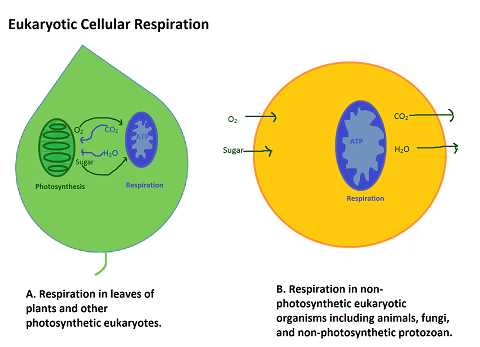
The process of energy production within cells is intricate, but a clear visual representation can make it much easier to grasp. When studying this biological mechanism, it’s crucial to focus on the specific components that drive energy conversion. The chart you are working with provides a breakdown of each step involved, highlighting the enzymes, molecules, and structures that play a key role in turning nutrients into usable energy.
Start by examining the first step of glucose breakdown, which occurs in the cytoplasm. Here, glucose is split into two molecules of pyruvate. This is the foundation for further processes in the mitochondria. Pay attention to the intermediate products that are formed, as they are critical for the next phases, where high-energy molecules are generated.
Next, the mitochondria take over, where the pyruvate is fully oxidized through a series of reactions that include the Krebs cycle. This stage is where the majority of energy carriers, such as NADH and FADH2, are produced. These molecules are then passed to the final phase of energy creation, the electron transport chain, where the bulk of ATP is synthesized. Ensure that you note the flow of electrons and protons during this stage and how it leads to the generation of energy that powers cellular functions.
By understanding these steps and referring to the diagram, you can better connect the theoretical knowledge with the visual breakdown. Take time to identify each molecule and its movement through the different compartments within the cell. Recognizing these components will enhance your ability to understand how cells efficiently generate the energy required for life processes.
Cellular Energy Production Process Breakdown
Refer to the following chart to understand the specific elements involved in energy production. The key molecules and steps are broken down for clarity. This is a guide to help match each part of the visual to its corresponding function.
| Step | Location | Key Components | Role |
|---|---|---|---|
| Glycolysis | Cytoplasm | Glucose, ATP, NAD+ | Breakdown of glucose into two molecules of pyruvate, producing a small amount of ATP and NADH. |
| Pyruvate Decarboxylation | Mitochondrial Matrix | Pyruvate, CoA, NAD+ | Pyruvate is converted into Acetyl-CoA, releasing CO2 and transferring electrons to NADH. |
| Krebs Cycle (Citric Acid Cycle) | Mitochondrial Matrix | Acetyl-CoA, NAD+, FAD, ADP | Complete oxidation of Acetyl-CoA into CO2, producing NADH, FADH2, and ATP. |
| Electron Transport Chain | Inner Mitochondrial Membrane | NADH, FADH2, O2 | Transfer of electrons through proteins, generating a proton gradient that drives ATP synthesis. |
| ATP Synthesis | Inner Mitochondrial Membrane | Proton Gradient, ADP, Pi | Protons flow back through ATP synthase, producing ATP from ADP and inorganic phosphate. |
This table outlines the core stages of the process, focusing on the movement of molecules and energy carriers. Matching these details with the corresponding labels on the image will give a complete view of how cells generate and store energy.
Overview of Energy Production Stages
The process of energy generation in cells consists of several stages. Each step is a critical part of breaking down organic molecules to produce ATP, the primary energy currency in cells. Below is a breakdown of the main stages involved in the process:
| Stage | Location | Key Steps |
|---|---|---|
| Glycolysis | Cytoplasm | Glucose is split into two molecules of pyruvate, generating small amounts of ATP and NADH. |
| Pyruvate Decarboxylation | Mitochondrial Matrix | Pyruvate is converted into Acetyl-CoA, releasing CO2 and transferring electrons to NADH. |
| Krebs Cycle | Mitochondrial Matrix | Acetyl-CoA undergoes a series of reactions to produce ATP, NADH, and FADH2, while releasing CO2. |
| Electron Transport Chain | Inner Mitochondrial Membrane | Electrons from NADH and FADH2 pass through protein complexes, generating a proton gradient across the membrane. |
| ATP Synthesis | Inner Mitochondrial Membrane | The proton gradient drives the synthesis of ATP through ATP synthase, completing the process of energy production. |
For more in-depth information on the stages of energy production, visit reputable educational resources such as Khan Academy Biology, which provides comprehensive and up-to-date explanations.
Understanding Glycolysis in the Diagram
Examine the first step in energy production, where glucose is broken down into two molecules of pyruvate. In the chart, identify the key enzymes and intermediates involved in this process. Look for the conversion of glucose into two molecules of G3P (glyceraldehyde-3-phosphate), which are further processed to produce pyruvate.
Focus on the energy investment phase, where ATP molecules are consumed to phosphorylate glucose. The energy payoff phase follows, generating ATP and NADH. This phase results in a net gain of 2 ATP molecules per glucose molecule. Make sure to locate the key steps, such as the conversion of G3P into pyruvate and the reduction of NAD+ to NADH.
The diagram will show how these transformations take place in the cytoplasm, with specific enzymes facilitating each step. Be sure to trace the path of electrons and note where NADH is generated, as this molecule will play a significant role in later stages of energy production.
The Role of the Mitochondria in Energy Production
The mitochondria are the primary sites for the second and third stages of energy production. Once pyruvate enters the mitochondria from the cytoplasm, it undergoes further processing. Pay attention to how the mitochondrial matrix is involved in the conversion of pyruvate into Acetyl-CoA, which feeds into the Krebs cycle.
In the diagram, observe how the inner mitochondrial membrane plays a key role in the electron transport chain. Here, NADH and FADH2 donate electrons, which are passed through protein complexes, creating a proton gradient across the membrane. This gradient powers ATP synthesis through ATP synthase. Without mitochondria, these processes would not take place efficiently, significantly reducing ATP production.
Focus on the two main regions of the mitochondrion shown in the visual: the outer membrane, which allows molecules to enter, and the inner membrane, where energy transfer and ATP generation occur. These components work together to maximize the cell’s energy output.
How ATP Production is Shown in the Process
Look closely at the final stages of the process to see how ATP is generated. In the chart, notice how high-energy electrons from NADH and FADH2 are passed through protein complexes in the inner mitochondrial membrane. This creates a proton gradient across the membrane, which is crucial for ATP production.
The ATP synthase enzyme, also shown in the diagram, uses the flow of protons back through the membrane to drive the conversion of ADP and inorganic phosphate into ATP. Focus on how the proton gradient is established and how it directly influences ATP synthesis as protons flow through ATP synthase.
Keep track of the amount of ATP generated at each step: Glycolysis yields 2 ATP, the Krebs cycle generates 2 more, and the majority of ATP (about 28) is produced through oxidative phosphorylation in the electron transport chain. These steps are all clearly marked to show the flow of energy throughout the process.
Identifying Key Molecules in the Energy Production Process
Focus on the main molecules involved in the breakdown of glucose and the generation of ATP. In the visual, locate glucose, which is the starting molecule. It is split during the first stage to form two molecules of G3P (glyceraldehyde-3-phosphate), which are later converted into pyruvate. This step is critical for initiating the subsequent phases.
Next, track the key electron carriers: NAD+ and FAD. Both molecules are involved in the transfer of electrons during the Krebs cycle and the electron transport chain. These carriers are reduced to NADH and FADH2 as they pick up electrons, which are crucial for generating ATP in later stages.
In the final stages, look for oxygen (O2), which serves as the final electron acceptor in the electron transport chain. Oxygen binds with electrons and protons to form water, a byproduct of the entire process. These molecules play a critical role in the movement of energy within the cell, driving the production of ATP from ADP and phosphate.
Detailed Labeling of the Krebs Cycle in the Process
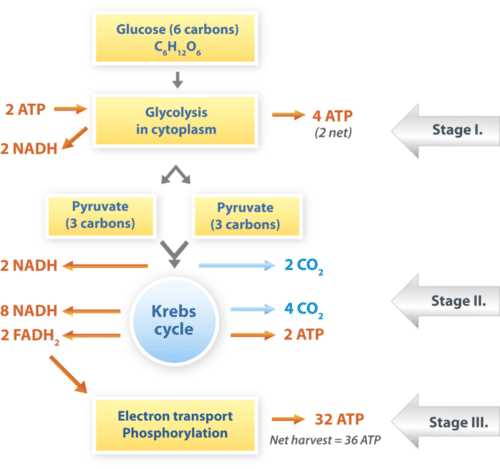
In the chart, identify the key steps of the Krebs cycle. This cycle occurs in the mitochondrial matrix, and each stage is associated with specific molecules and reactions. Focus on the following key components:
- Acetyl-CoA: The entry molecule into the cycle, derived from pyruvate.
- Citrate: Formed by the combination of Acetyl-CoA and oxaloacetate. This is the first intermediate in the cycle.
- NADH and FADH2: Electron carriers formed when NAD+ and FAD are reduced during various steps, notably during the decarboxylation of intermediates.
- CO2: Carbon dioxide is released during the conversion of intermediates, particularly during the decarboxylation reactions.
- ATP (or GTP): A molecule of ATP or GTP is produced via substrate-level phosphorylation during the cycle.
- Oxaloacetate: The molecule that combines with Acetyl-CoA at the start and is regenerated at the end of the cycle, allowing it to continue.
Track the flow of these molecules through each reaction and notice how energy is transferred in the form of high-energy electrons carried by NADH and FADH2. This cycle also generates two molecules of CO2 for each glucose molecule processed.
Interpreting the Electron Transport Chain in the Process
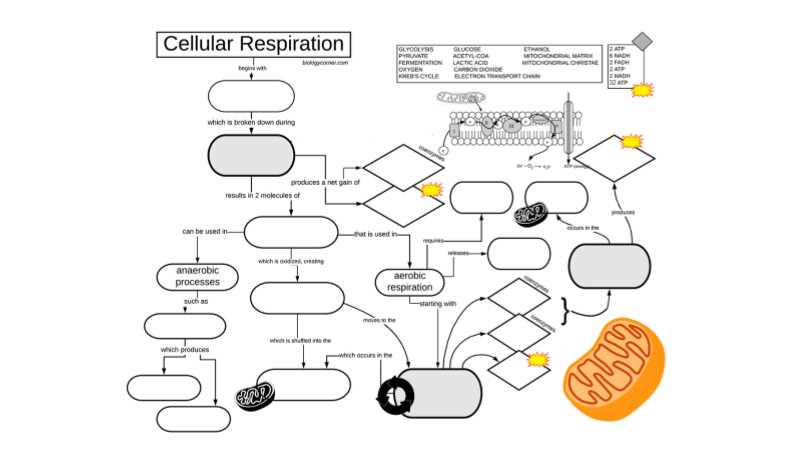
Focus on the inner mitochondrial membrane where the electron transport chain (ETC) occurs. In the chart, identify the protein complexes and how electrons flow through them. Here’s what to look for:
- Complex I (NADH dehydrogenase): NADH donates electrons to this complex, which initiates the chain. Electrons are passed to ubiquinone (Q), reducing it to ubiquinol (QH2).
- Complex II (Succinate dehydrogenase): FADH2 donates electrons to this complex, also passing them to ubiquinone, but without contributing to the proton gradient.
- Ubiquinone (Q): This mobile electron carrier transports electrons from Complex I and II to Complex III.
- Complex III (Cytochrome bc1 complex): Electrons are transferred from ubiquinol to cytochrome c, while protons are pumped across the membrane, contributing to the proton gradient.
- Cytochrome c: This small protein carries electrons from Complex III to Complex IV.
- Complex IV (Cytochrome c oxidase): Electrons are transferred to oxygen, the final electron acceptor, which combines with protons to form water.
- Proton gradient: As electrons move through the complexes, protons are pumped into the intermembrane space, creating a gradient that drives ATP synthesis.
Make sure to track how the electrons move from NADH and FADH2, through the complexes, to oxygen. This flow generates the proton gradient, which is key for ATP production by ATP synthase in the next step.
Common Misunderstandings in Energy Production Diagrams
Several common misconceptions can arise when interpreting visual representations of energy production. Here are the key areas where errors are most often made:
- Misplacement of Pyruvate: Pyruvate is often incorrectly shown as entering the mitochondria before it undergoes the necessary decarboxylation. Ensure it is first converted to Acetyl-CoA inside the matrix before entering the Krebs cycle.
- Electron Transport Chain and Oxygen: A common misunderstanding is that oxygen is involved earlier in the chain. Oxygen actually accepts electrons at the very end, combining with protons to form water.
- ATP Production from NADH and FADH2: Some diagrams may overestimate the ATP yield from NADH and FADH2. For each NADH, approximately 3 ATP are produced, and for each FADH2, 2 ATP are produced during the electron transport chain.
- Proton Gradient in ATP Synthesis: It’s sometimes unclear that the proton gradient is created by the electron transport chain across the inner mitochondrial membrane, not by the Krebs cycle itself.
- Role of Complex II (Succinate Dehydrogenase): This complex is often mistakenly shown as contributing to the proton gradient. In reality, it only transfers electrons to ubiquinone (Q) without directly pumping protons.
- Energy Yield per Glucose: Some diagrams mistakenly show the full ATP count from glucose metabolism as being produced in one stage. Keep in mind that glycolysis, the Krebs cycle, and oxidative phosphorylation each contribute a specific amount of ATP.
By carefully checking the placement of molecules and understanding the roles of each complex, these misunderstandings can be avoided for a more accurate interpretation of the entire process.